I have created this site to help people have fun in the kitchen. I write about enjoying life both in and out of my kitchen. Life is short! Make the most of it and enjoy!
Yesterday I posted about my introduction into the world of aging meats, with Chef Justin Brunson. Brunson Meat Company What I didn’t tell you is that Justin also makes his own bacon too. I came home with a couple different types of Justin’s bacon, and of course I was very eager to try it out. Because of course, we all know, EVERYTHING is better with bacon, and it’s exceptional with really, really good bacon too. 🙂
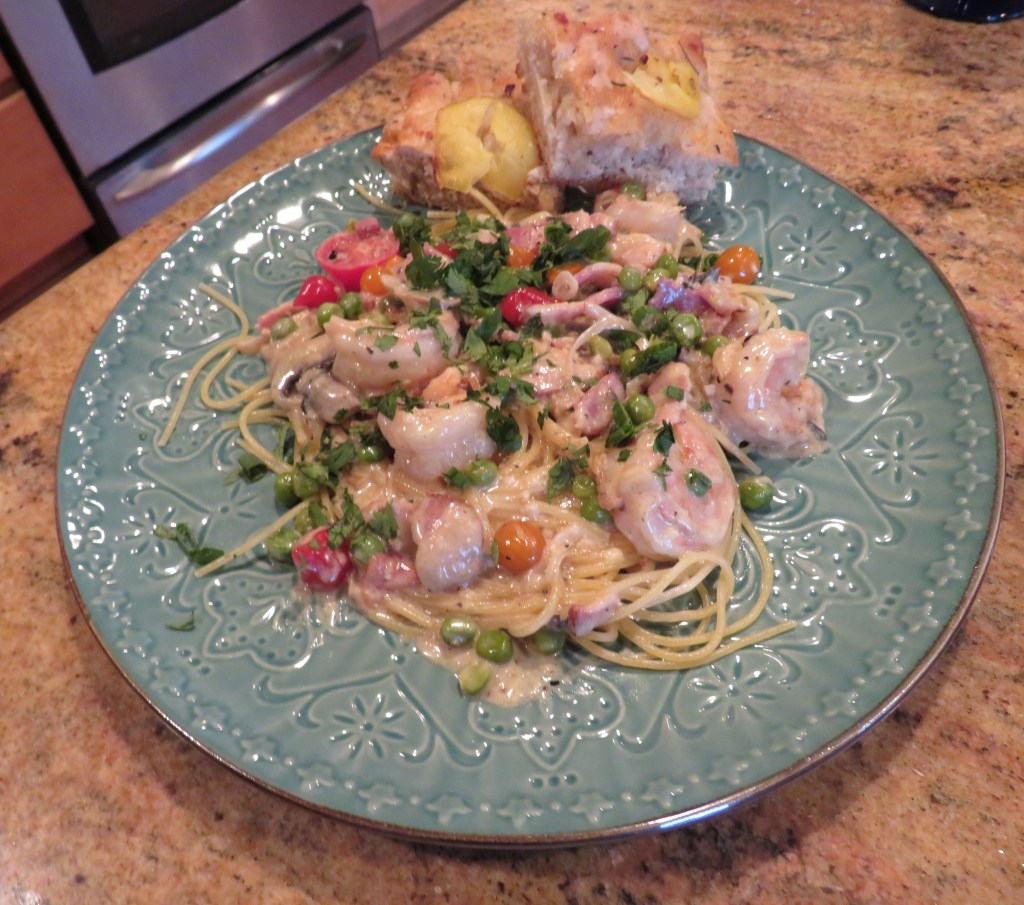
Originally I was planning on doing bacon wrapped shrimp and serving it over pasta, but the weather was a bit too nippy for me to go out and grill my shrimp. So instead, I just made it more like a carbonara/Alfredo style shrimp and bacon pasta dish. I am a big fan of peppered bacon, so I used the pepper bacon for my dish. OMG!!!! WOW!!!! The flavor of Brunson Meat CO bacon was phenomenal! The flavor just popped and made the whole dish really come to life like never before. It’s always been really good, but this time, it was exceptional!
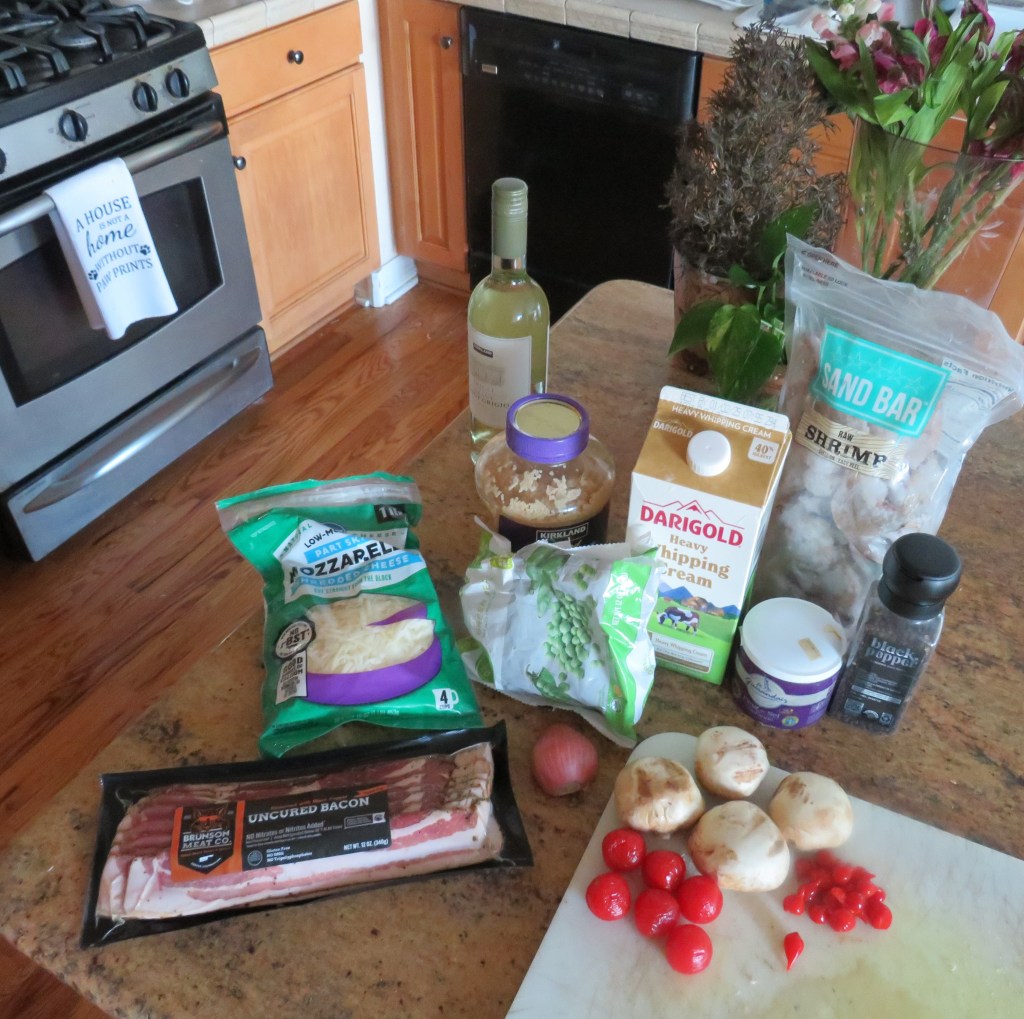
You have seen many versions of this shrimp and pasta dish before on my blog posts. Obviously, shrimp and pasta with a creamy Alfredo or carbonara sauce is a favorite of mine. I always make it a little different too, depending on what I have on hand at the time. This time I added mushrooms, shallots, garlic, peas, tomatoes and Peruvian peppers to the mix.
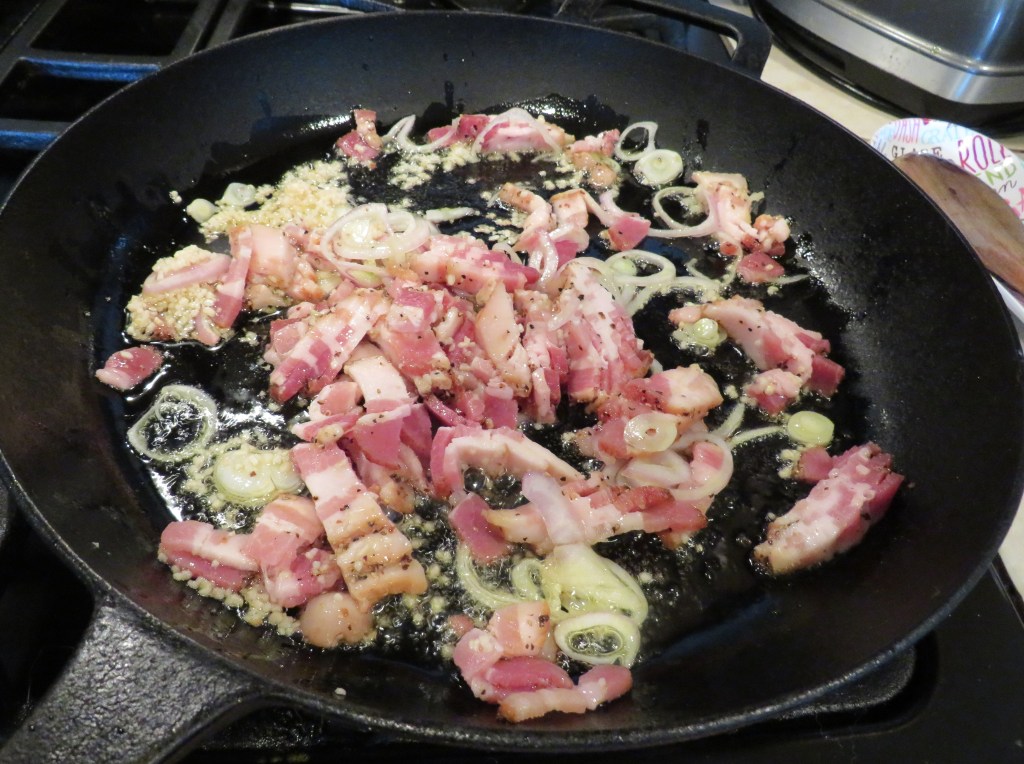
First, I cooked the bacon, garlic and shallots in olive oil.
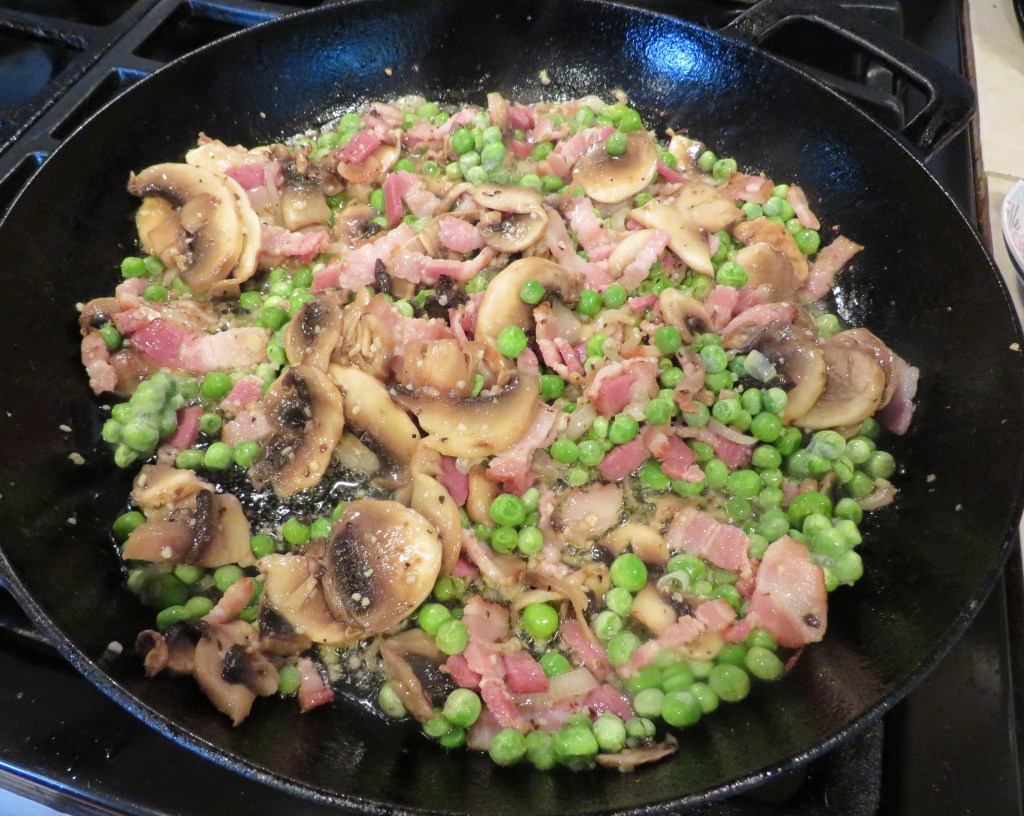
Then I added the peas and mushrooms.
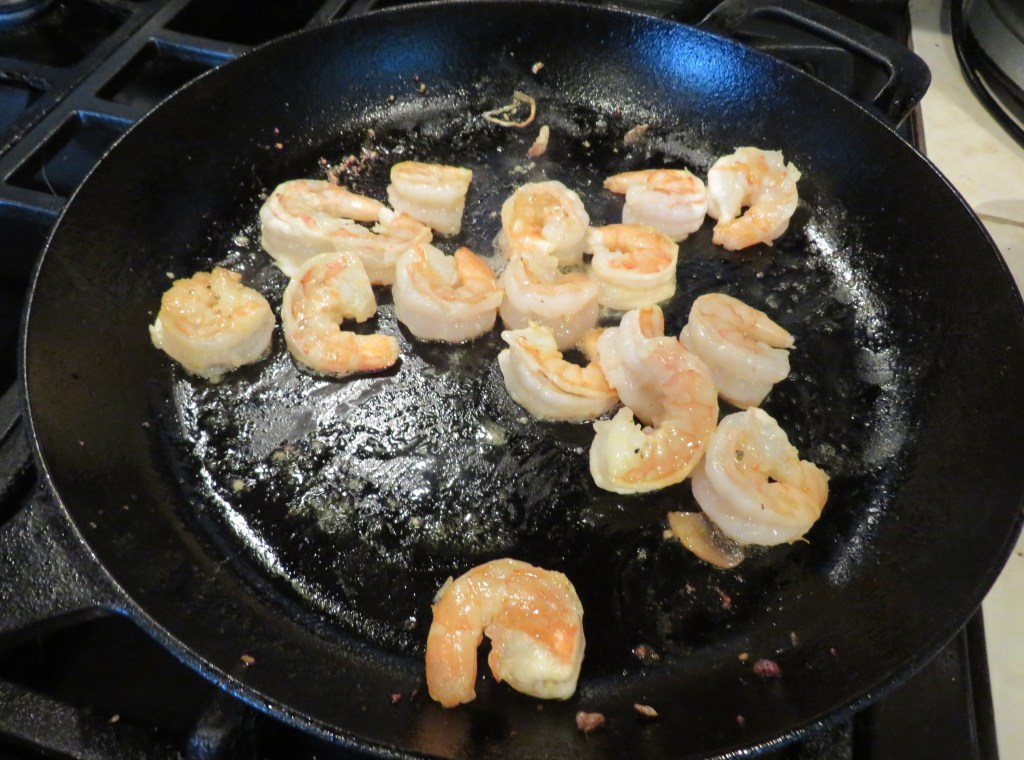
Once the vegetable mixture was cooked, I removed them from the heat, then cooked my shrimp.
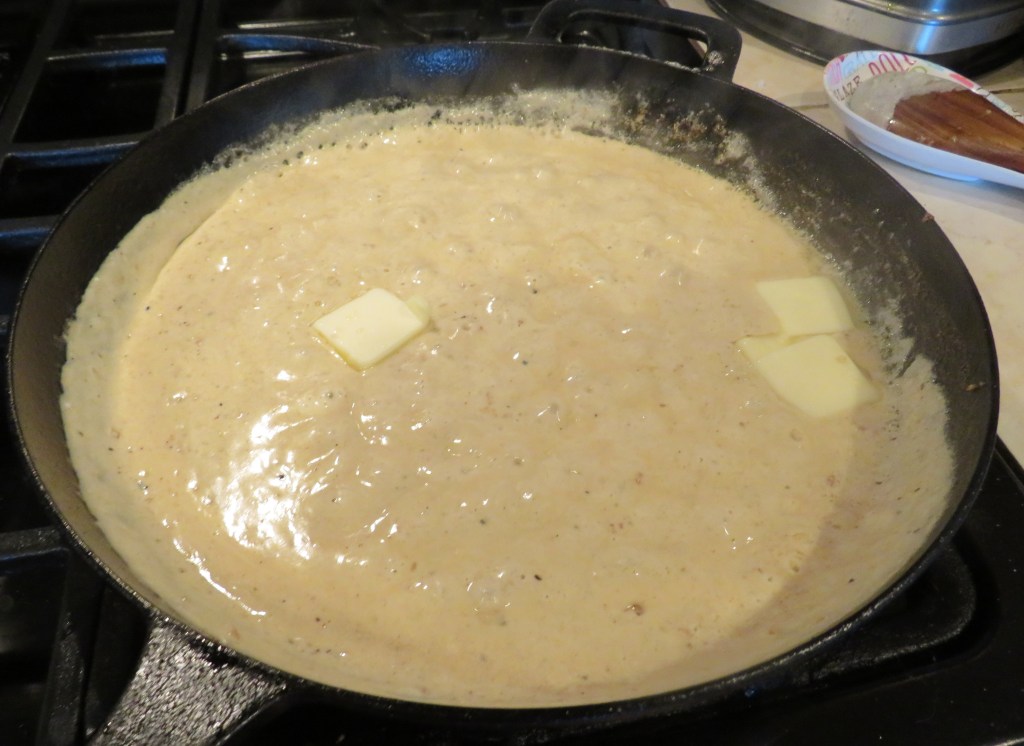
After the shrimp was cooked and removed, I made my Alfredo sauce, starting with a dry white wine to deglaze my pan, then adding my heavy whipping cream and Mozzarella cheese, salt & fresh ground black pepper, and finishing it off with butter.
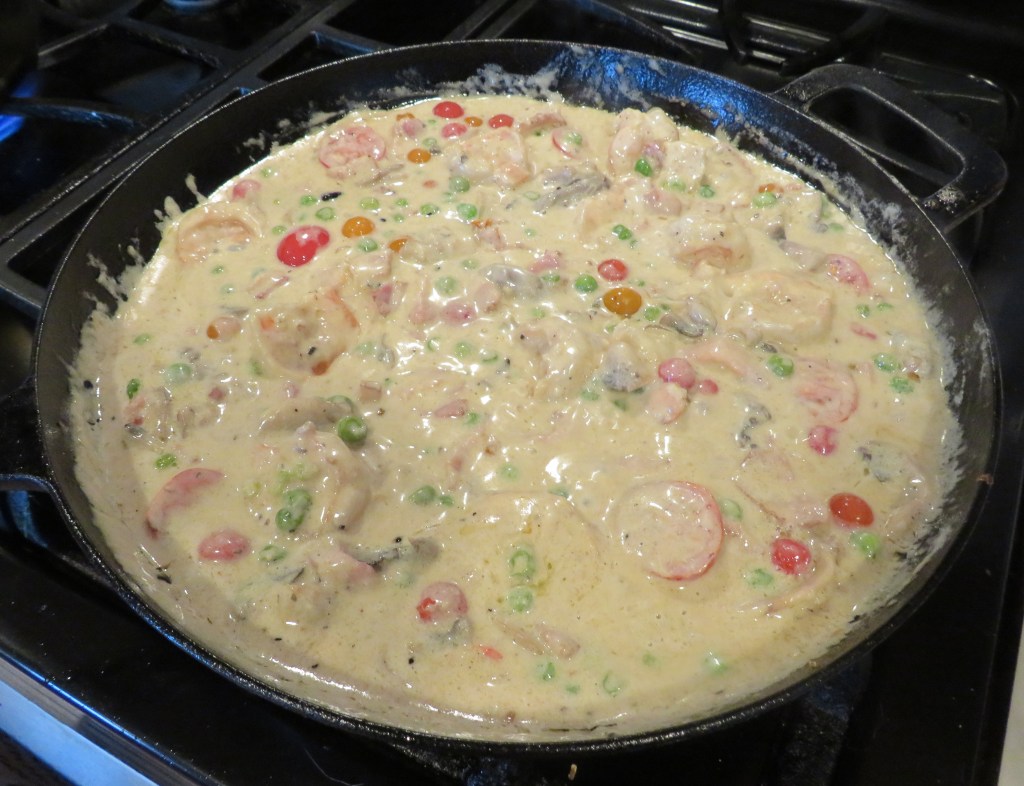
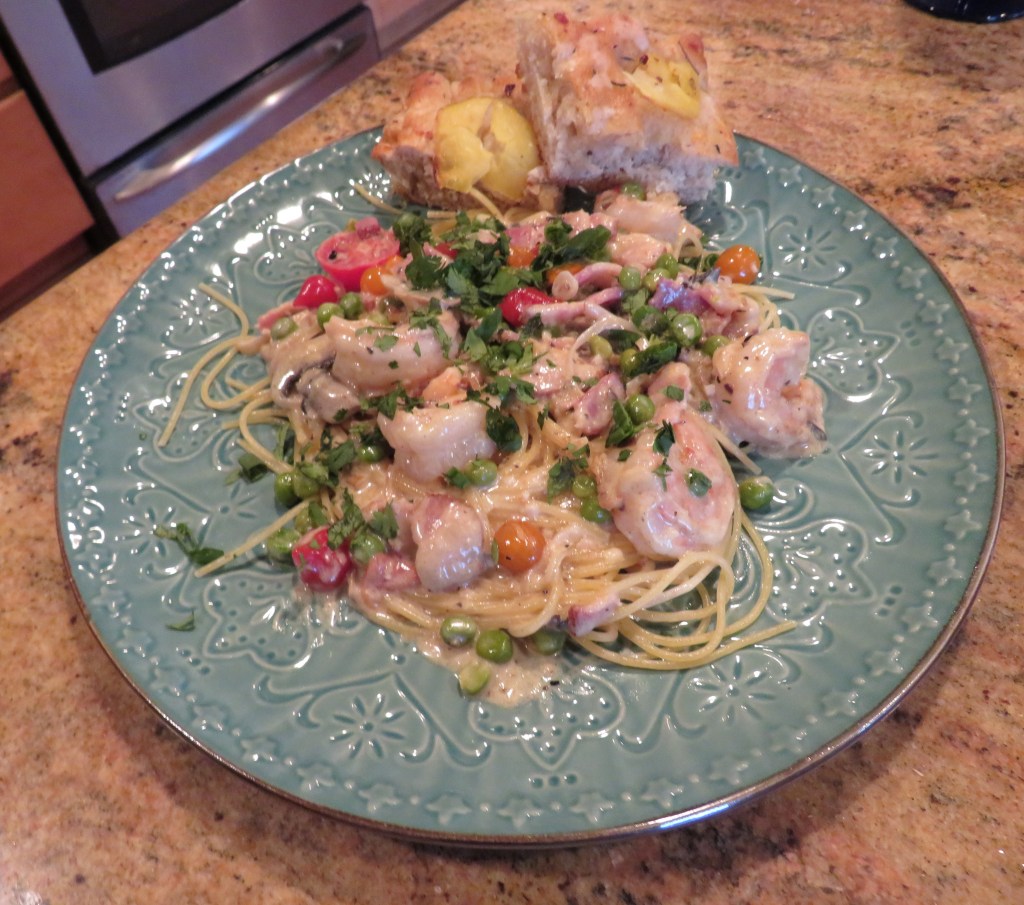
I re-added both the vegetable mixture and shrimp and incorporated it all into the sauce, adding just a little drizzle of lemon juice, then served it up over angel hair pasta.
Because I LOVE my breads, and still had some of my potato focaccia left, Potato Focaccia I warmed that up and added it to the meal, with a cool, crisp Pinot Grigio on the side. I didn’t give an actual recipe this time, because as I said, you have seen many different versions of this dish before. But I wanted to highlight just how much better the dish was by using really good, high quality bacon, such as the bacon from Brunson Meat Co. Quality really does matter, and you can definitely taste the difference too. I have always said that, and this is how I have always cooked, but this time I raised the bar considerably, and all by just adding a better quality bacon to the mix. 🙂
Thank you once again Justin, for a fantastic day of learning all kinds of new things, and for the fabulous steak and bacon. What a delightful treat. 🙂
Have a great day and make everyday great. Stay safe and stay well, and stay warm if you live in cold country. ‘Til next time.
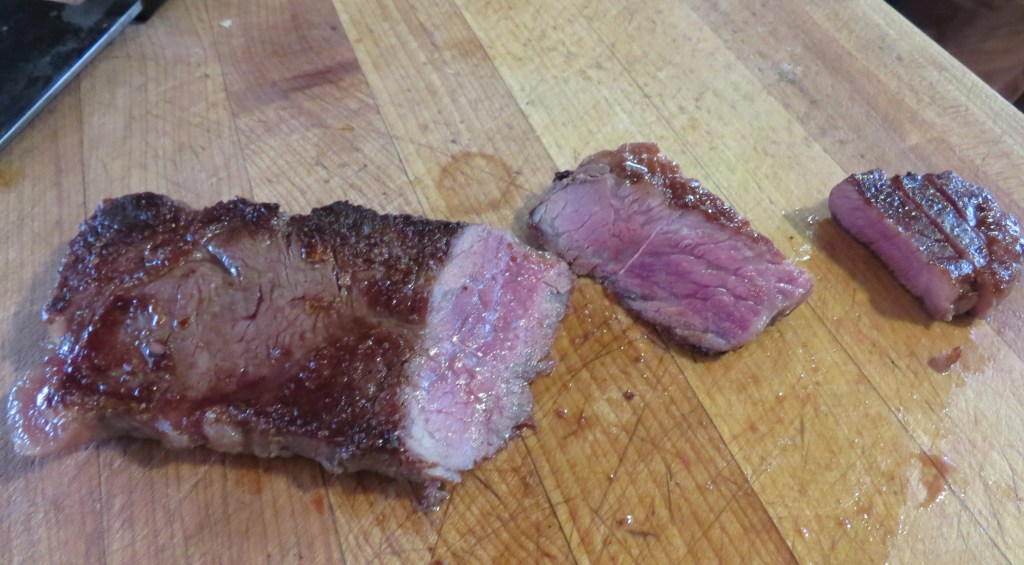
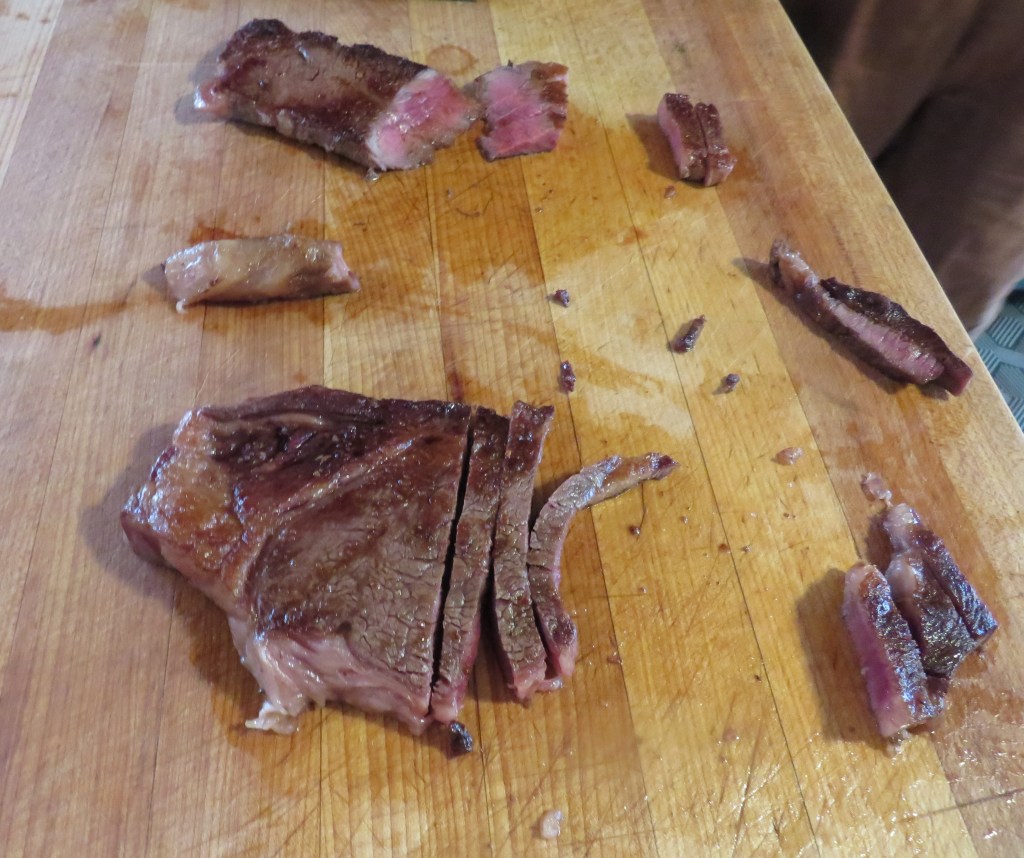
A perfect steak is one that doesn’t take much fuss, is juicy, full of flavor and just melts in your mouth. I make good steaks. In fact, I think I make very good steaks. But yesterday, I think I had a perfect steak, thanks to Chef Justin Brunson, owner and founder of Brunson Meat Company, here in Denver.
I met Justin through LinkedIn. We share a common love of food, and steaks in particular. I met up with him yesterday. First he had me go to his house, where we talked food and steaks, and then he cooked up a couple of perfect steaks for us to try. I was in Heaven! He cooked a NY steak and a ribeye to absolute perfection, with nothing but a little coarse salt for additional flavorings. Both were fabulous, and completely different. The NY steak had flavors of hazelnuts and buttery popcorn, and the ribeye had hints of bleu cheese. Nothing else was added to the steaks but the coarse salt. These flavorings come naturally through Justin’s dry aging process.
These steaks were perfect for a few reasons. One, Justin is a master butcher and chef and has owned a few high end steak houses all around Colorado, both in and around Denver, as well as the touristy mountain resort areas. And Justin certainly KNOWS his steaks! He starts with the best beef from the best cattle in the country. He said he likes the Black and Red Angus Beef and buys all his beef from ranches in Nebraska. He likes the Nebraska beef and cattle because they are bigger cows and they produce a lot of marbling in their meat, which adds extra flavor, as well as makes them more tender. Those are definitely reasons enough, but his real secret to a perfect steak is in the dry aging method that he created.
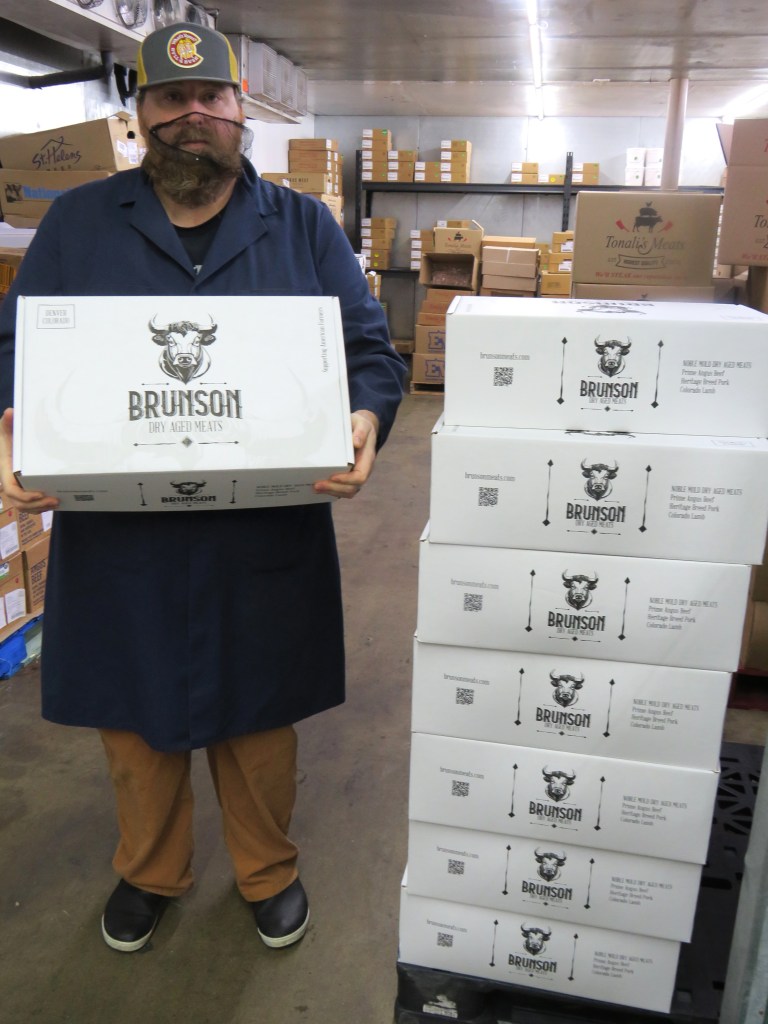
Meet Chef Justin Brunson, the mastermind behind Brunson Meat Co. Justin’s journey to aging meats began in the kitchens of Denver, Colorado. Growing up in the heart of Iowa’s farming country, he was surrounded by farmers and open pastures at a young age. As an acclaimed chef, butcher and maker of fine salumi and whole muscle cures, Justin started to develop a much deeper appreciation for the art of aging and sharing quality experiences with friends, clients and family.
Drawing on years of experience and a knack for innovation, Justin has created a process for curing and dry-aging meats that’s as diverse as it is delicious. From prime dry aged steaks over live-fires to mouthwatering bacon crisped in cast-iron, each product tells a story of tradition, craftsmanship, and preservation.
Justin has spent the last two decades building relationships with notable chefs and restaurants, supplying some of the best dinner tables across the country.
Sourcing from Responsible Farming Partners: We ensure top-quality meat from sustainable sources.
Advanced Dry-Aging and Bacon Rotation: Our climate-controlled environment guarantees premium dry-aged beef and bacon.
Flexible Packaging & Cutting Plans: Custom cutting and portioning are important to us because they are vital to you.
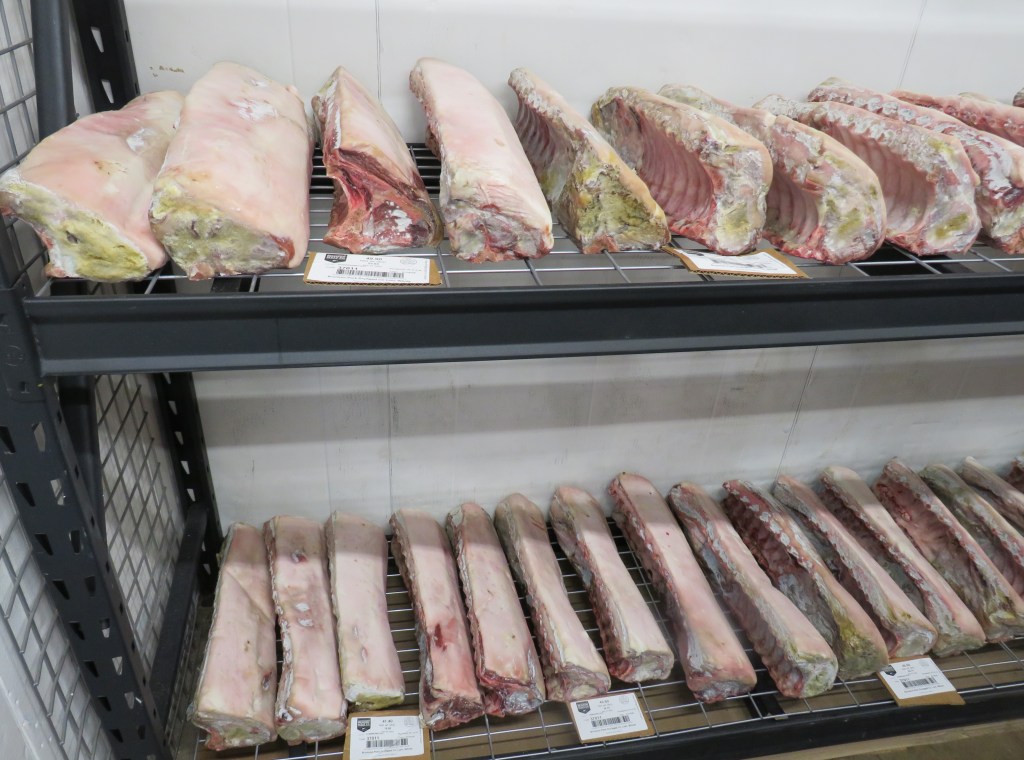
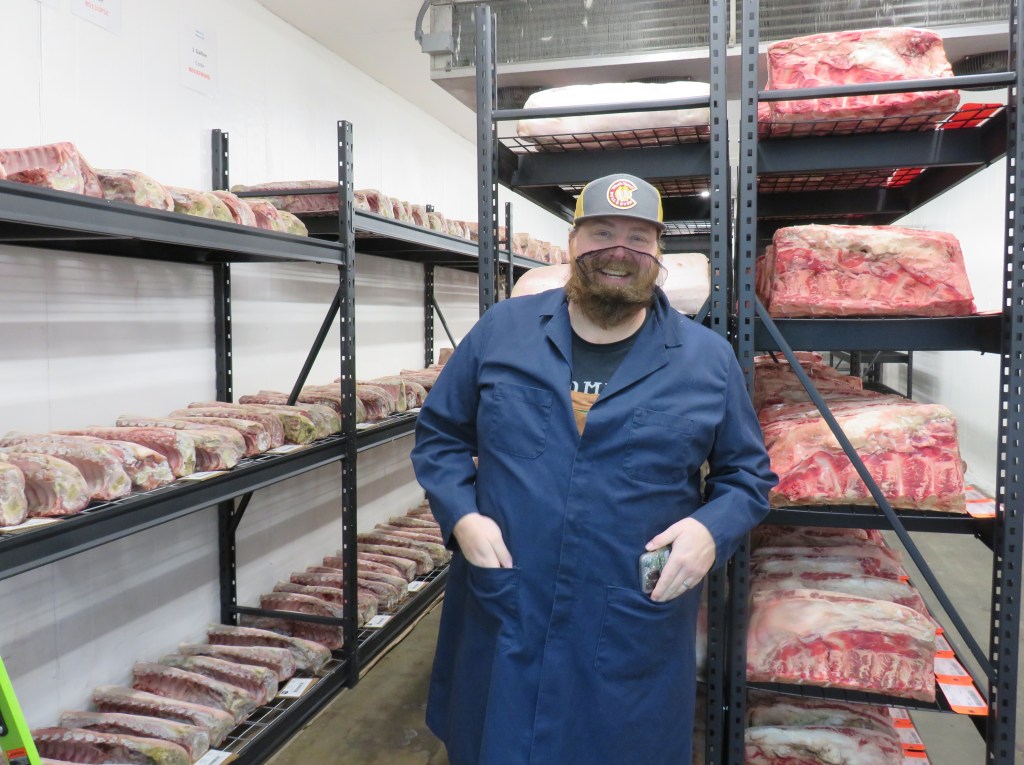
After sampling some absolutely perfect steaks, Justin took me to his drying unit, at Tonali’s Meats, also in Denver. All of this was brand new to me, and I was so excited to learn about the meat processing and aging. Tonali’sMeats has been processing some of the best steaks in Denver for over 60 years. They are located at 3890 Dahlia St. Denver, CO 80007. You can call them and order from them at (303) 940-8700, though they are mostly wholesalers who sell to restaurants and meat vendors.
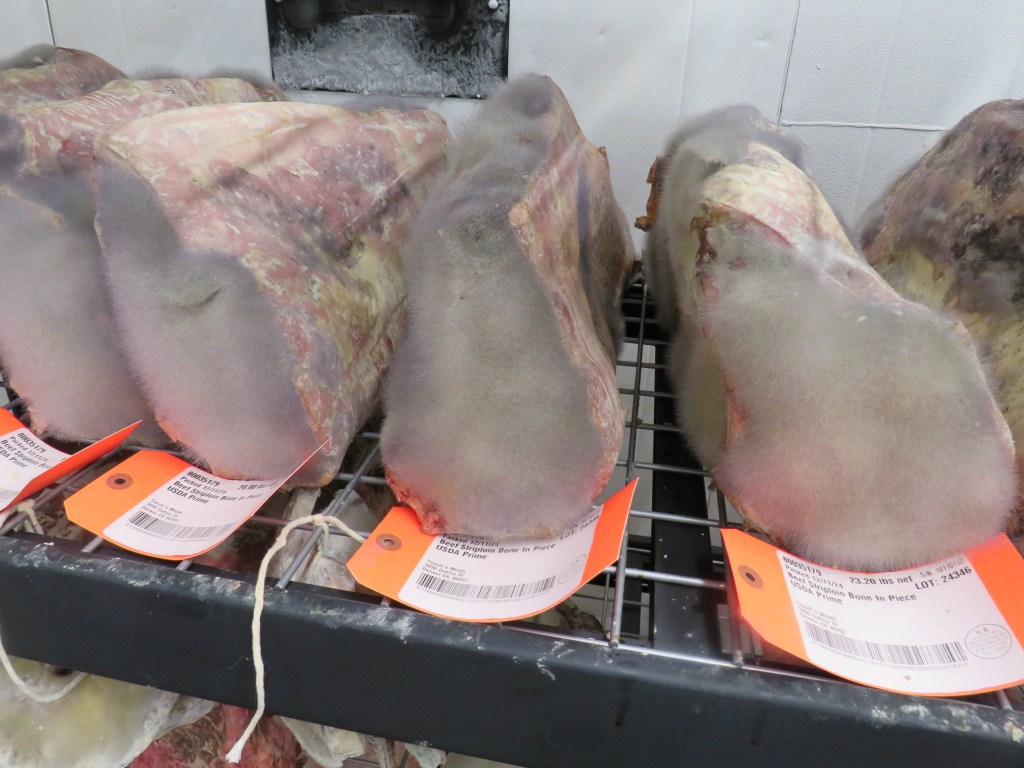
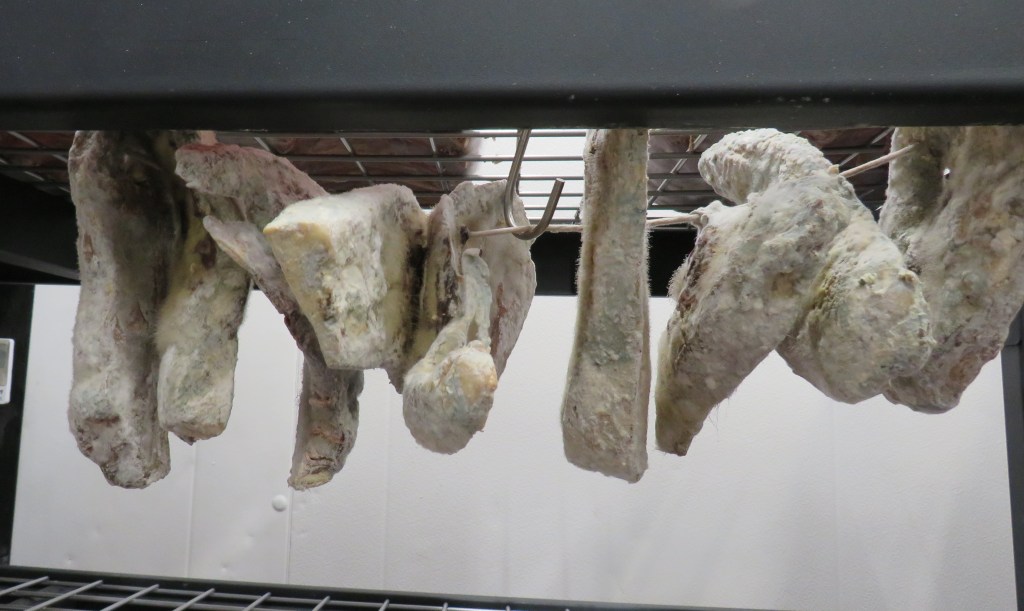
Justin’s secret to his aging process comes from mold. Yes, you read that right, mold, just like you would find being used to dry salamis and to age cheeses. He ages his meats anywhere from 35-45 days in a cold refrigerated room kept at about 34-36 degrees F, then cuts off the mold and processes the meat. He re-uses the moldy ends that have been cut off and the whole process begins again. The “moldy ends” are used like a starter for sourdough bread, and live indefinitely. All of Justin’s meats are USDA certified, and the meat certifiers check the meats daily.
Justin ages pork as well, using the same dry aging method. He is also thinking of branching out to start aging venison, elk and bison too.
This aging room is just one of a few that Justin has. This is his only drying room in Colorado, and then he has two additional rooms, even larger than this one, in Iowa. He currently has about 4000 lbs of meat just in this drying room in Denver. This is a whole lot of EXCELLENT meat!
Justin is very proud of the quality of his meat, as he should be too. It is some of the best steak I have ever tasted. 🙂
Not only is Justin a great chef and butcher, but he also has a big heart and works with a lot of local charities too.
Justin Brunson is proud to support Risers 4 Rett, a charity that has raised nearly $1 million for the Rett Clinic at Children’s Hospital Colorado through annual fly fishing events. Since 2014, this dedicated group of volunteers have created a fun, relaxing way for fishing enthusiasts of all levels to contribute to a meaningful cause. Whether you’re a novice or an expert, every cast helps make a difference.
2. Making a Difference, Together! We’re incredibly proud to share that through our partnership with We Don’t Waste, we’ve been able to provide 100,484 servings of food to our local community in 2024! Every bite matters, and we’re honored to work alongside such an amazing organization dedicated to reducing food waste and feeding those in need. Thank you for supporting Brunson Meat Co. and helping us give back to our community. Let’s continue making a positive impact together! #WeDontWaste #CommunityImpact #BrunsonMeatCo #DenverColorado.
Every time you bite into a delicious Brunson steak, not only are you going to experience some of the most delicious steaks and meat you’ve ever tasted, but you will also be helping out some local Denver and Colorado charities too.
Justin and I had a great time together, and I learned so much from him. I am so glad we had a chance to meet and to partner up. Thank you Justin for a deliciously fun and informative day. I thoroughly enjoyed the whole experience.
Have a great day and make everyday great. Stay safe and stay well. And always, keep learning. There is so much great stuff out there to learn, just waiting to be discovered and shared with others. ‘Til next time.
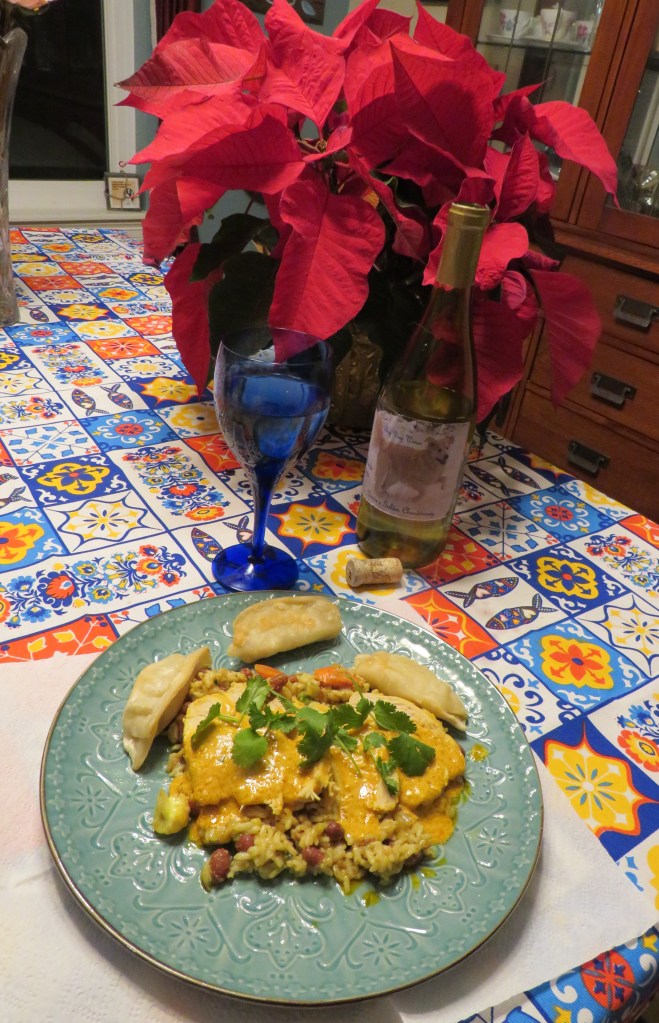
I was going to make this dish a few days earlier, but plans changed and it got pushed back a couple of days. No problem. I made it for just Larry and I rather than sharing it with Mike and Lauren too. I made butter chicken, or murgh makhani.
Butter chicken is a dish that originated in Delhi, India. It was created at the Moti Mahal Restaurant in the 1950’s, by adding butter and tomatoes (makhan) to the sauce for the chicken. Its sauce is known for its rich, creamy texture. It is similar to chicken tikka masala, which uses a tomato paste. It resulted from a cooking experiment when the leftover marinated chicken was combined with a rich tomato-based gravy (Indians call any kind of sauce gravy), resulting in a heavenly creation. Traditionally this is more of a restaurant dish rather than something people make at home because the chicken is cooked in a tandoor oven, and most people do not have a tandoor oven at home. But when there is a will, there is a way. Today, many people make their own versions in the comfort of their own kitchens, like I did, without a tandoor oven.
Butter Chicken
2-3 lbs chicken – I used breasts, but you can use pieces or a whole chicken too if you prefer.
2 cups plain yogurt
1 TBSP garlic
1 TBSP ginger
1/2-1 tsp red pepper flakes, or to taste
1 tsp chili powder
1-2 tsp paprika
1/4 tsp coriander
1 tsp cumin
1 tsp garam masala
1 tsp turmeric
2 tsp lime juice
salt to taste
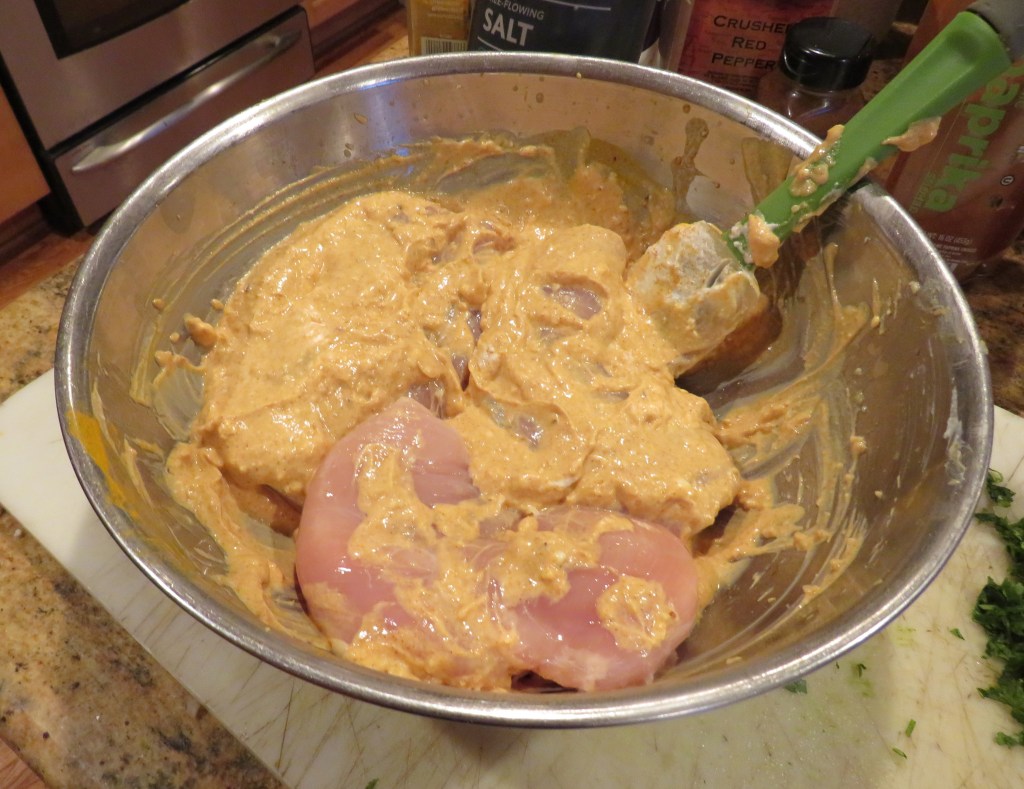
Mix everything together and let the chicken marinate for 1-2 hours, or even overnight if you like before cooking it.
Get a large skillet very hot and add oil and/or butter or ghee. Cook the chicken completely, with the sauce.
The Makhani Sauce
1 1/2 lbs tomatoes, roasted
1/2 tsp fenugreek
3 oz butter
1/2 tsp paprika
few drops of vinegar
1/4 tsp garam masala
salt
3-4 TBSP heavy whipping cream.
Combine everything for the Makhani sauce and put it in the food processor, except for the cream. Add to the chicken and sauce, then add the cream and butter and incorporate into the sauce. Continue cooking for an additional 2-3 minutes, stirring constantly, or until everything is fully incorporated into the sauce. I confess, I completely skipped this whole step. I was in a hurry and was feeling rushed, and just overlooked this part. But no worries, the chicken still came out great, and this step wasn’t even missed. 🙂
I served this over over a rice dish with vegetables and red kidney beans or Pulao, with some warmed naan bread and potstickers, and a cool, crisp chardonnay on the side (one of our own chardonnays that we made too). I was going to make some samosas, but Larry was hungry and wanted potstickers instead. No problem. I am definitely flexible when it comes to the kitchen.
This dish was a delicious way to help warm things up, especially since it was frigid outside.
Have a great day and make everyday great. Stay safe, stay well, and stay warm. ‘Til next time.
I love baking bread, especially when the weather outside is frightful. And it has definitely been frightful lately too. Our high today is only going to be 7*F or -14*C. BRRRR! Some of the best ways to fight the frigid weather are to stay indoors, to bake bread, and make a big pot of hot soup. I did all of the above. We stayed inside. I made a big pot of split pea soup Split Pea Soup and I made a potato focaccia.
I make all kinds of focaccia, on a regular basis. But I had never made a potato focaccia before now. They are all fun to make, and all are delicious too. I don’t have a favorite. I enjoy them all. This focaccia was a little different than my usual ones though, because I used both regular flour and whole wheat flour, and I added potatoes both to the dough and on top of the focaccia before baking.
Potato Focaccia
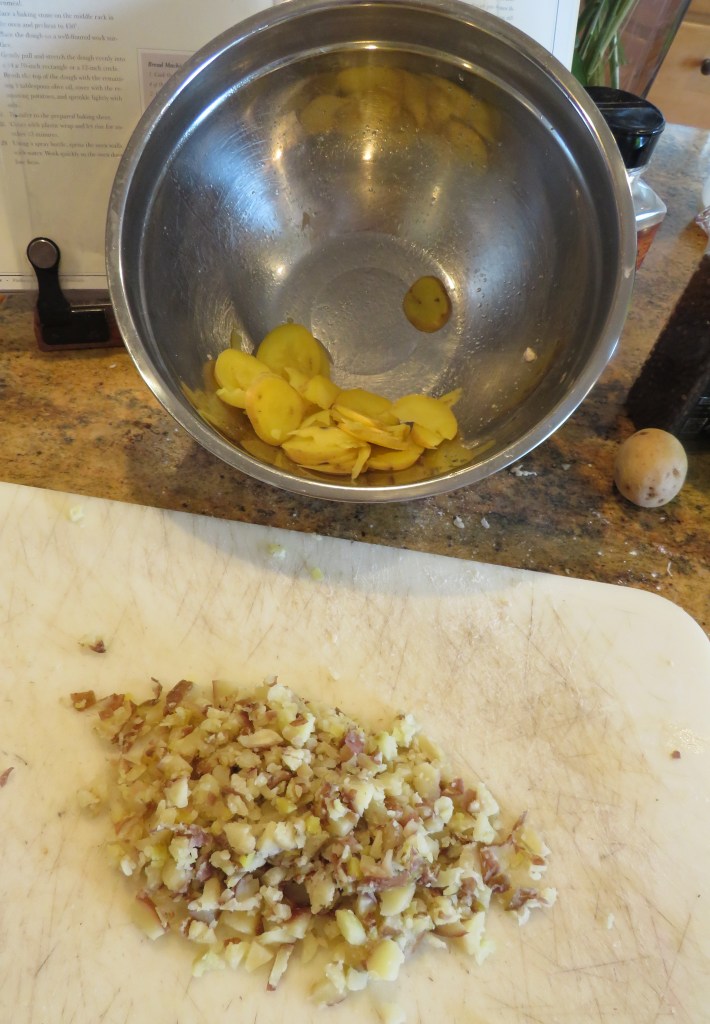
First I par-boiled the potatoes. Some I diced very small and some I sliced very thin. I used the diced potatoes for the dough and added the sliced potatoes to the top of the focaccia right before placing it in the oven.
6-7 small new or red potatoes, 34/ diced small and 1/4 sliced thin
1/4 cup olive oil
2 tsp dry active yeast
3-4 cups flour
1/2 cup whole wheat flour
1 1/2-2 cups water
2 tsp coarse salt
1/2-1 tsp fresh ground black pepper
2 tsp dried thyme and/or marjoram
1/4-1/2 tsp red pepper flakes or to taste
olive oil for drizzling on top
Par-boil the potatoes for about 12-15 minutes. Then drain and let cool, reserving 1 1/2 cups of the water.
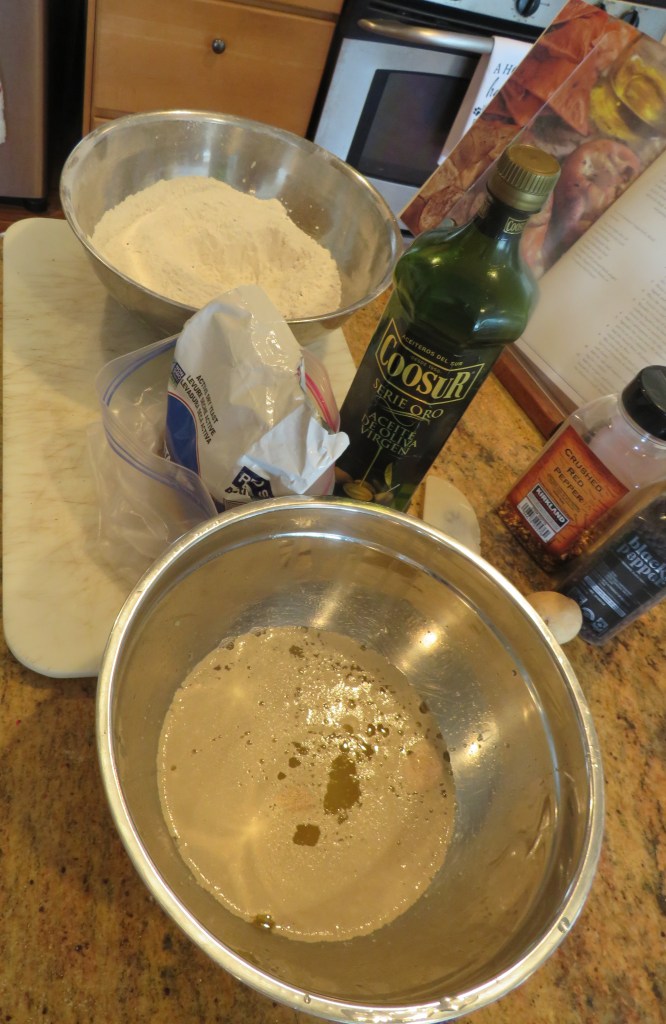
Combine the flours and dry ingredients together and make a well in the center.
Add the yeast and 1/4 cup of olive oil to the reserved potato water, whisk together and let set for about 2-5 minutes.
When the yeast mixture is frothy, add it to the center of the flour mixture and mix from the inside out until it is all mixed together. Then knead on a lightly floured surface for about 6-8 minutes, or until it forms into a soft dough. Add more flour as needed. Place the dough in an oiled bowl, cover and let rise for about an hour or until it doubles in size.
Cut the potatoes and set aside.
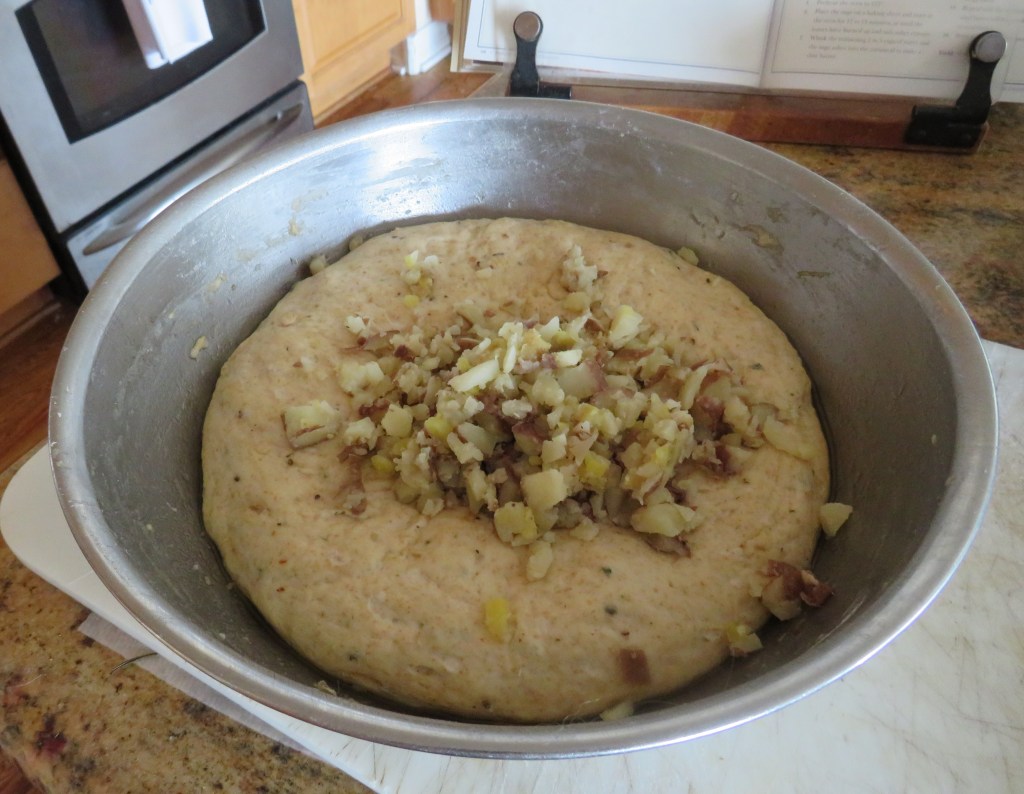
Add the diced potatoes to the dough and fold in until they are all incorporated into the dough. Cover again and let rise for another 30 minutes.
Preheat the oven to 450*F or 232*C.
Add some olive oil and cornmeal to the bottom a baking sheet and spread around evenly.
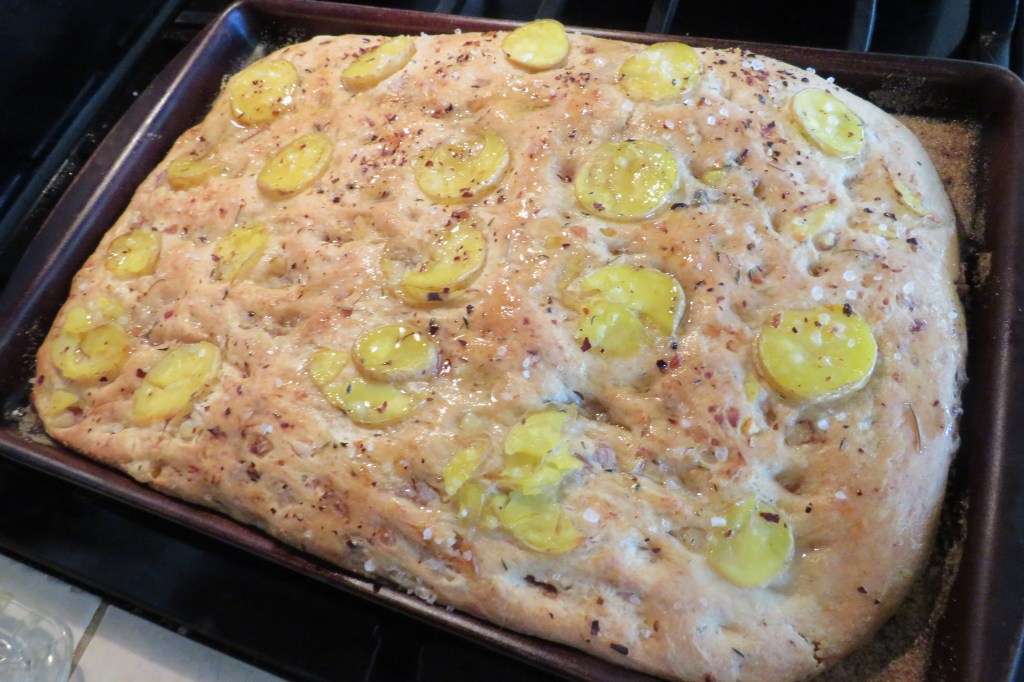
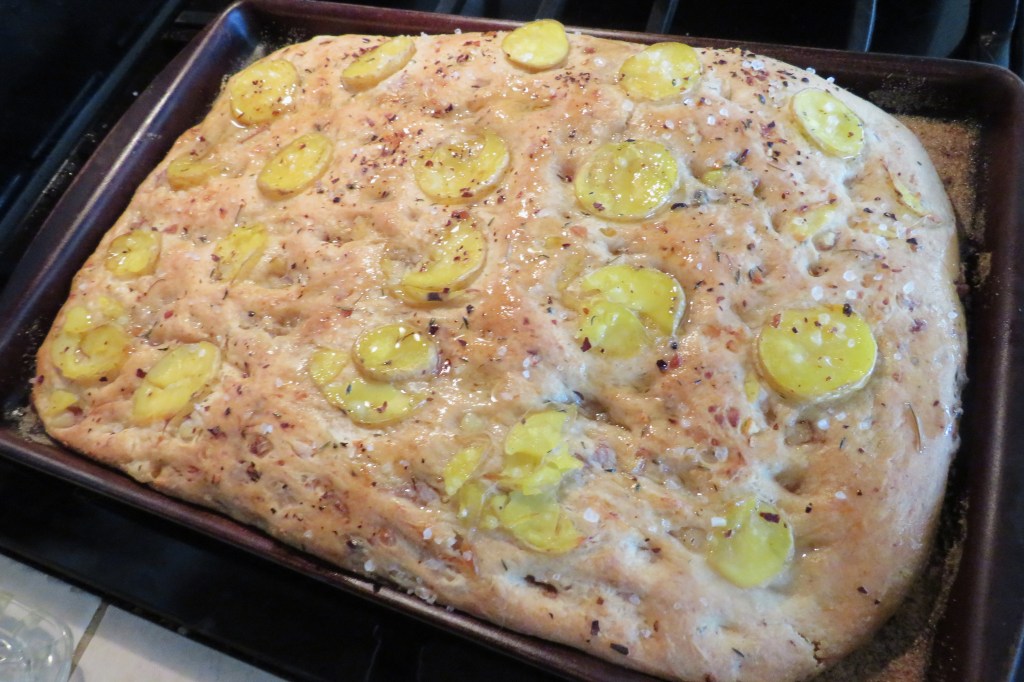
Place the dough onto the prepared pan and pat it out to fit the pan with your hands. Then dimple the dough with your fingers to let out some of the extra gases. Place the sliced potatoes on top of the dough. Add a little more of the dried thyme, coarse salt and red pepper flakes, optional on top. Drizzle more olive oil on top.
Bake for about 15-20 minutes, or until golden brown and slightly crispy. Spray the oven with water 3 times within the first 10 minutes of baking to ensure a crispy crust. Allow the focaccia to cool slightly before slicing it.
It came out so light and fluffy. In keeping with the Italian tradition, I dipped it in olive oil mixed with a little fresh ground pepper and balsamic vinegar too. DELICIOUS! !Mangia!
Have a great day and make everyday great. Stay safe, stay well and stay warm. ‘Til next time.
I don’t know what’s going on in our house, but we have been eating a lot of leftovers lately. It seems like much more so than usual. I don’t feel like I am making larger batches of food, but we certainly seem to have a lot more leftovers than usual. Maybe it’s just because we started eating less, which is certainly the case, meaning, we have more meals of the same dishes. All I know is that because we are having more leftovers, I am cooking less. It’s bittersweet, but it is what it is. Have no fear though, I WILL ALWAYS be cooking, just sometimes not as often. Oh well. These things happen. But by cooking less, I have more time for more crafting.
I mentioned awhile ago that I am doing a lot of crafts with all my many buttons lately. Button Up I started working with my buttons to use them up, but it seems like my button collection is actually growing rather than diminishing. My buttons just keep multiplying. Here are some of the latest things I’ve been working on.
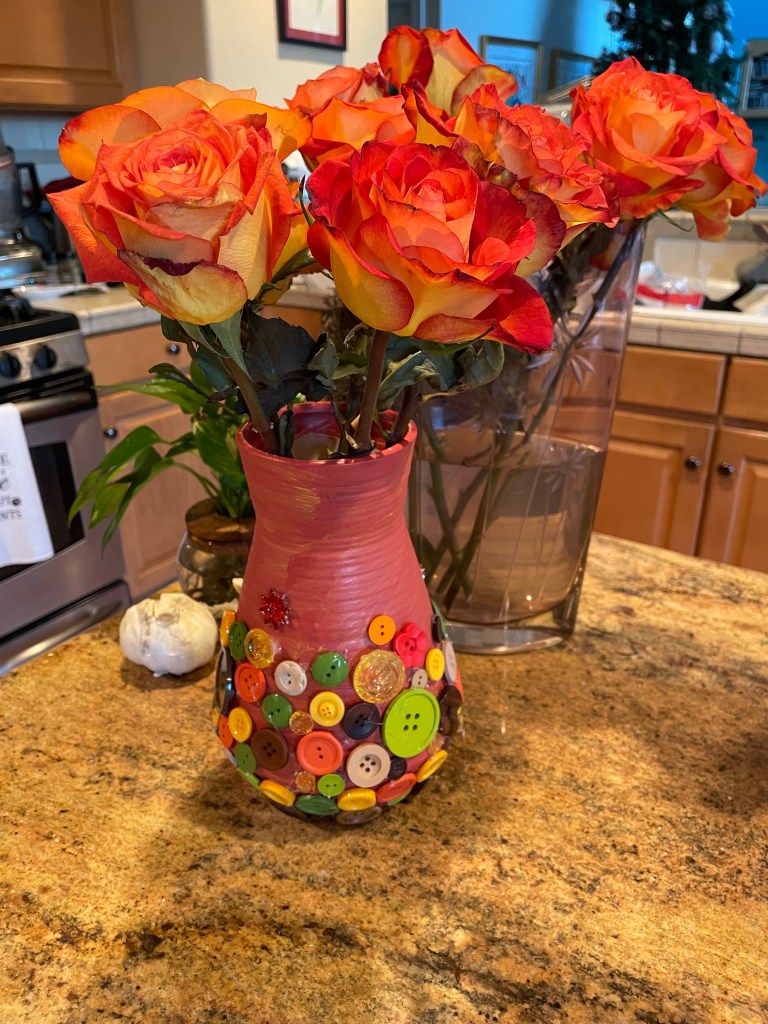
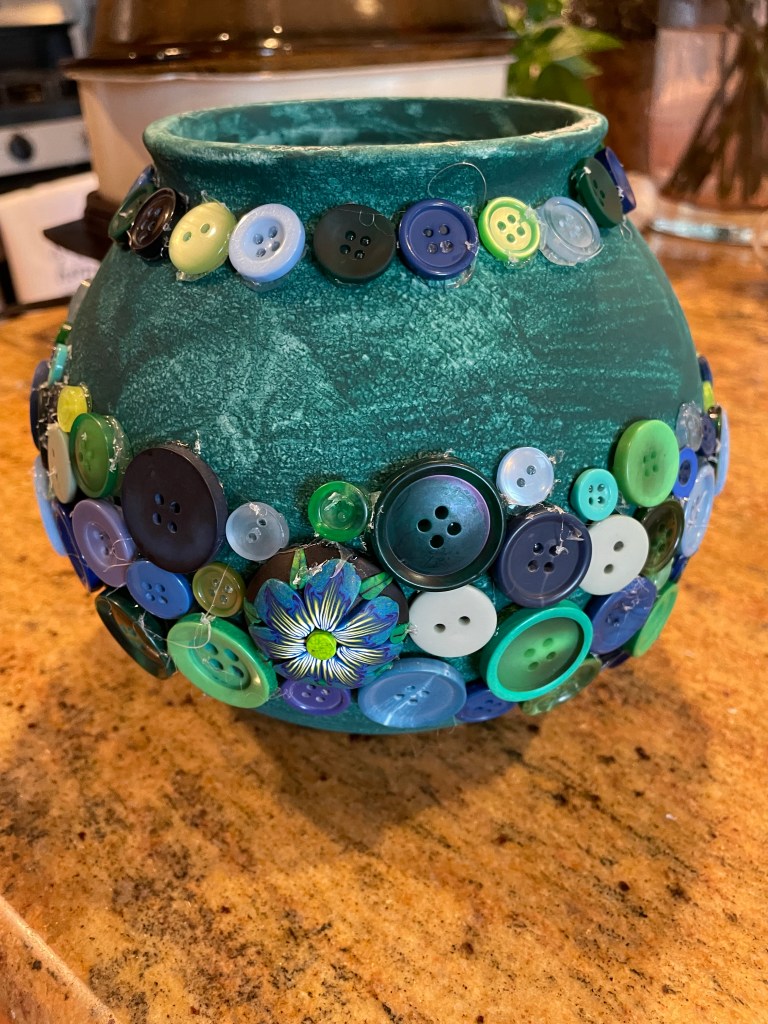
I’ve been busy creating colorful button vases.
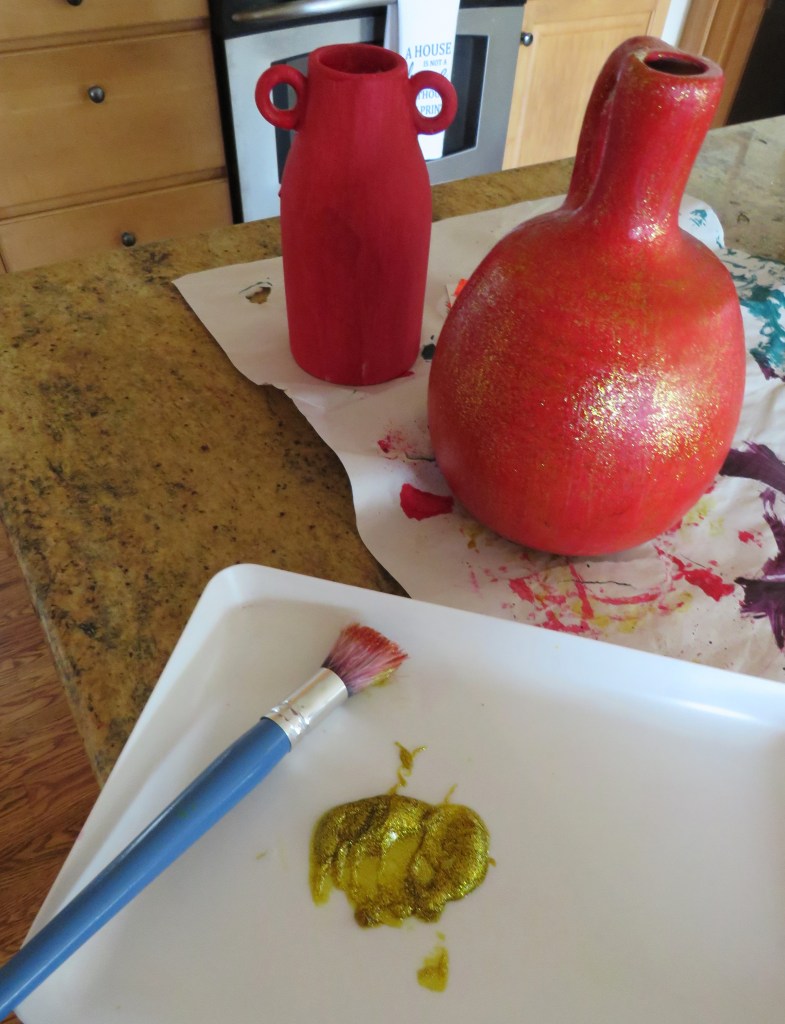
First I paint them in different colors.
And sometimes, I give them a second coat of a different color, with sparkles.
After the paint is dried, I decorate them with coordinating colored buttons.
I like using the terra cotta vases. I like the earthy texture from the terra cotta. Each vase has it’s own personality and they are all different.
Before giving these out, I have to make sure I clean up all the excess glue off the buttons, vases and other projects. Sometimes it is easier to clean them once the glue is fully dried. These are all spoken for, but if anyone wants anything, I am more than happy to create something that is one-of-a-kind for you. 🙂
I mentioned above that my button collection seems to be growing rather than shrinking, however, that being said, I am actually making a small dent in some of my buttons. But I have lots more projects in mind too. In case you haven’t noticed, I am very creative person. I am always thinking up something creative to do. I get that from my mom. In fact, I was always the creative force pushing her on ideas and then we would work on them together. I sent my cousin some of my pictures and she said I have inspired her with some creative button ideas too, using buttons from her mom, my aunt Gloria.
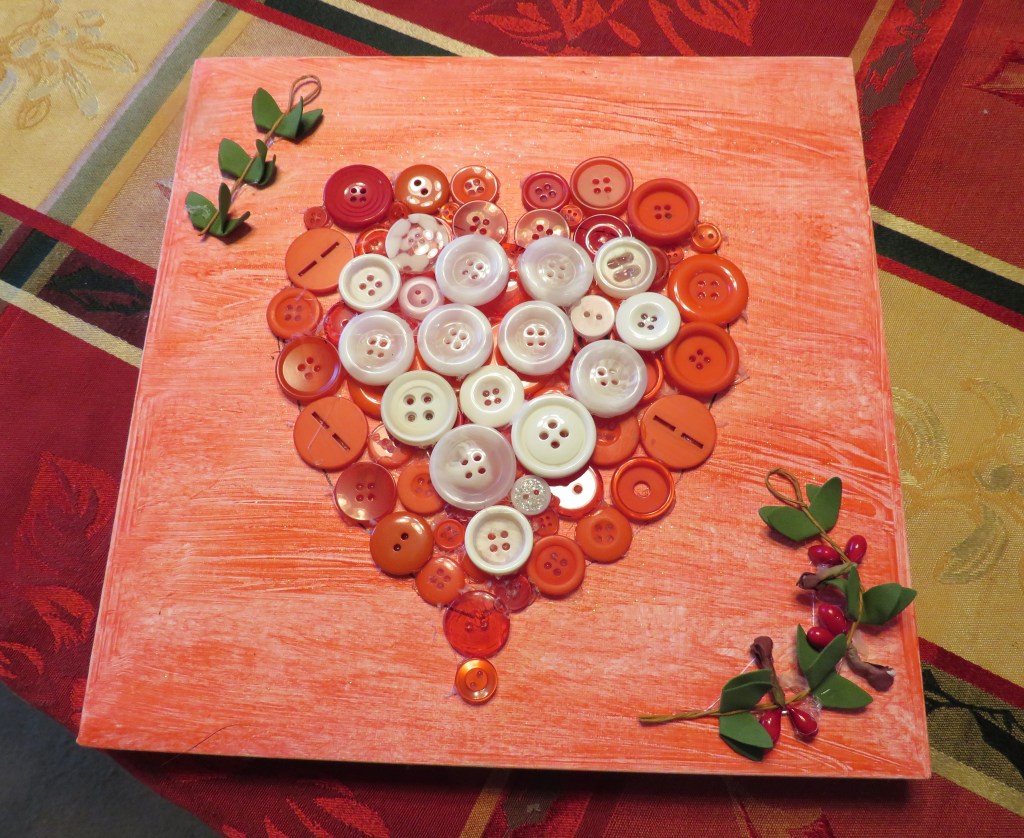
Here are some of my other fun button projects too.
This was my first button creation. I actually have it hanging on my kitchen wall now. I love my tree of life creation. 🙂
I still have a ton of buttons, and I still have a ton of ideas too. 🙂
Be creative and have fun, especially if you are bound to the indoors because of inclement weather. Let your imaginations run wild. The possibilities are endless. Have a great day and make everyday great. Stay safe and stay well. ‘Til next time.
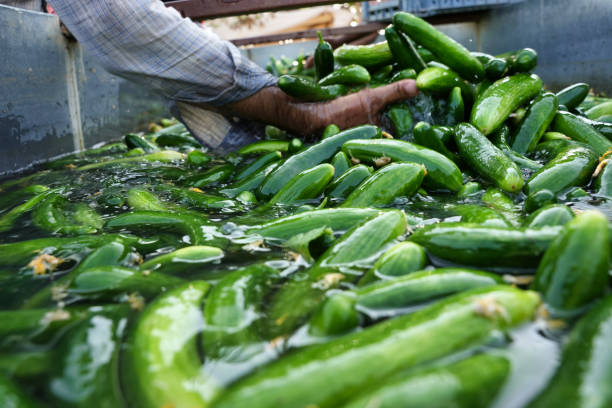
Cucumbers are cool refreshing vegetables that we always seem to associate with summer and warm weather. This is because of their cooling, refreshing qualities.
Anyone who eats pickles knows that cucumbers are used for making pickles. It was the Ancient Egyptians who introduced the brining of cucumbers to make pickles, around 2035 BCE. The term pickle is derived from the Dutch word pekel, meaning brine. The brining and pickling is done with many different vegetables, not just cucumbers. Before the word pickle entered the English language, the Old English word for the vegetable was eorþæppel or earth-apple. But there is so much more to cucumbers than just using them for pickles or salads or dips. They are very versatile and have many health benefits as well.
Cucumbers are native to India and have been cultivated for over 3,000 years. They are now a staple in many cuisines, especially in Asia, the Middle East, and the Mediterranean. They spread from India to Greece, then to Rome, where the Romans introduced them to the rest of Europe. Once again, Christopher Columbus was instrumental in introducing them to other parts of the world, but this time, he brought them to the New World from the Old World, where usually it was the other way around, and he brought foods from the New World back home to the Old World.
Back in the ancient times, cucumbers were often used for medicinal purposes, such as treatments for scorpion bites and bad eyesight. They were even used to help scare off mice. They are still used for medicinal and healing purposes today, often as part of a facial or spa treatment. All that water in cucumbers can help keep you hydrated. Plus, the fiber boost they give you helps you stay regular and avoid constipation. The vitamin K helps blood clot and keep your bones healthy. Vitamin A has many jobs, like helping with vision, the immune system, and reproduction.
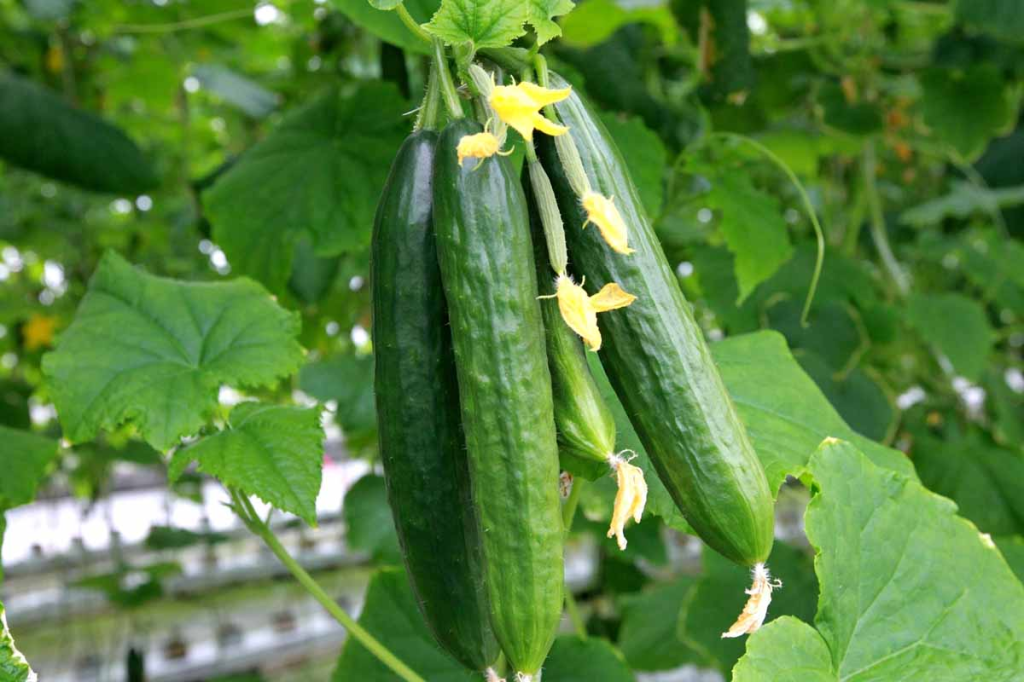
Because the seeds are found inside the fleshy center, cucumbers are considered to be fruits rather than vegetables. The seeds are the flavor packets of cucumbers, yet ironically, the seeds are what we normally throw away. They grow on a vine, and one vine can produce between 25-125 cucumbers, depending on the variety.
In today’s society, cucumbers are just another ingredient tossed into a salad, but, for the people in the early modern period, cucumbers were a representation of excess, salvation, and the ever-envious ability to have surplus. In the old days, having cucumber vines growing on your property was a status symbol. It is believed the Roman Emperor Tiberius ate cucumbers everyday.
Today, cucumbers are eaten all over the world. They are used for all kinds of recipes and dishes. The British have made them famous in the cucumber tea sandwiches. Now just about every culture uses cucumbers in many of their traditional foods and recipes. Today, the possibilities for incorporating cucumbers into recipes are endless.
The cucumber originates in Asia extending from India, Nepal, Bangladesh, China (Yunnan, Guizhou, Guangxi), and Northern Thailand, but now grows on most continents, and many different types of cucumber are grown commercially and traded on the global market. It seems everyone loves cucumbers, and rightfully so.
I hope you have all enjoyed learning a little more about these cool, refreshing fruits we all enjoy. Have a great day and make everyday great. Stay safe, stay well, and stay warm if you are in the cold belt right now. ‘Til next time.
I love my little American Kestrels. They are small members of the falcon family and they love the open spaces of Colorado. I am seeing more and more of hem on a regular basis, and I am perfectly OK with that too. The other day, while hiking around Metzger Farm, I saw a couple of Kestrels, high up in the trees. Even though I was at a distance, they saw me watching them, and they were posing for the camera.
I would have been happy if my Kestrels were all I saw that day, but as you know, my deer kind of escalated my joy to much higher level. Nature Walks – One Deer, Two Deer
Have a great day and make everyday great. If you are in the cold belt, like I am, stay inside and stay warm. ‘Til next time.
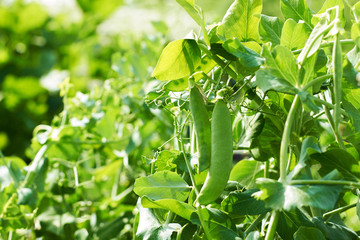
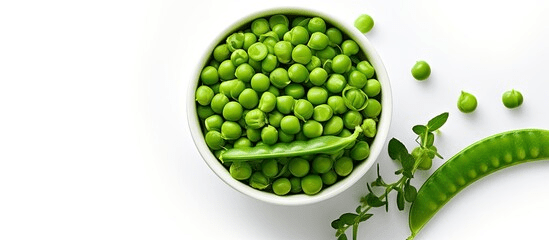
I’ve found you either love peas or hate them. There isn’t really any middle ground. I LOVE peas! I have always loved my peas. Maybe it’s because I have a lot of British/Australian/Celtic roots, or that peas are very popular in the South, and my mother was a Texan girl. Who knows? But I have always loved peas. I remember one time as a little girl, my parents took my to a nice restaurant. I must have been about 5 or 6 years old at the time, and there wasn’t anything I was interested in on the menu. I was NOT the food connoisseur I am today. But I saw peas were offered on the menu, and I politely asked the server if I could have a big bowl of peas with butter. He looked at me like I was some kind of freak, and I probably was (still am for that matter), but he brought me a big bowl of peas and butter. I was a very happy customer indeed.
Pease are in the legume family, but they are actually technically more of a fruit than a vegetable because the seeds are internal. Legumes are defined as members of the bean family. This family is large and diverse and contains over 16,000 species, including peas and beans of all kinds. In terms of importance to humans, the legume family is second only to the grass family. Every major civilization has had a legume as well as a grain as a part of their support system.
Peas originated in in the Middle East, in the Fertile Crescent, which is now Turkey and Iraq, and were among the first plants cultivated by humans around. They are some of the oldest cultivated crops in human history. Peas spread to Europe during the Neolithic period, around 8000 BC, and the first evidence of the garden pea in Europe is from Switzerland, around 3,000 BCE. There is evidence that people started eating wild peas about 23,000 years ago.
Originally peas were harvested and dried for storage, rather than eaten fresh. Dried peas were a great source of protein in lean times. Eating fresh peas was a luxury that didn’t really start becoming popular until around the 12th century. But they were an expensive luxury item for most people, and were too expensive for the main populations to eat on a regular basis. People didn’t actually start eating the pea pods until much later again, in the 17th century. Eating fresh peas or “fresh” frozen peas didn’t really become popular until the invention of the food-freezing techniques by the American company Birdseye, in the 1920’s. Today, peas, and legumes in general, are eaten by people around the world, on every continent, with the exception of Antarctica.
Some fun food facts about peas:
On average everyone in Britain eats nearly 9,000 peas per year.
The world record for eating peas is held by Janet Harris of Sussex who, in 1984, ate 7175 peas one by one in 60 minutes using chopsticks!
There are 35,000 hectares of peas grown in the UK each year, equivalent to about 70,000 football pitches. This produces about 160,000 tons of frozen peas – that’s 2 billion 80 gram portions.
Global pea consumption is set to reach almost 6 million metric tons by 2026. This represents a growth of 0.4% per year since 2017. India was the top consumer in 2021 with 2.3 million metric tons. China, Ethiopia and Bangladesh followed in that order.
Peas are a good source of vitamins C and E, zinc, and other antioxidants that strengthen your immune system. Other nutrients, such as vitamins A and B and coumestrol, help reduce inflammation and lower your risk of chronic conditions, including diabetes, heart disease, and arthritis.
Peas rank #7 on the top healthiest and nutrient packed list of vegetables.
Once again, we pea lovers can all thank Christopher Columbus for introducing the Old World to the peas and legumes from the New World.
I will always say yes please to peas. Have a great day and make everyday great. Stay safe and stay well. ‘Til next time.
I decided to switch my walks up a bit and went to nearby Metzger Farm. I always see so much when I go there. And once again, I was not disappointed. I was happy with the other things I saw, but when I saw my deer I was VERY happy indeed. This is is the second time I’ve seen deer at Metzger Farm. They are probably the same two deer too.
At first I saw the one deer, and I was able to get some great shots. Even though we were quite a distance apart, we were both watching each other for quite some time. But then I had an even better surprise. She was with a friend. I got quite a few good shots of both of them too. They are our local White-Tailed Mule Deer.
Always be prepared for the unexpected. Life is full of surprises. Make the most of all the surprises life brings to you. Have a great day and make everyday great. Stay safe and stay well. ‘Til next time.
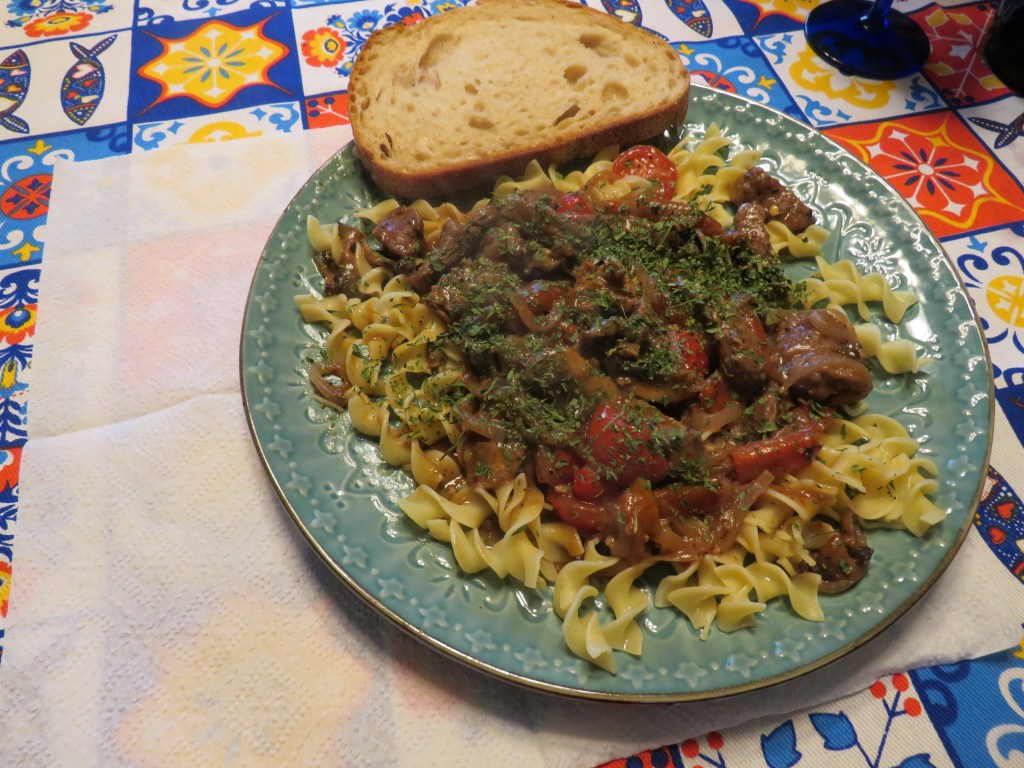
Larry was in the mood for steak, but we eat a lot of steak. I was in the mood for something else. Originally I was going to make beef stroganoff, but I didn’t have any sour cream and my yogurt had turned into a science experiment, so that was out. No problem. I quickly changed gears and made a spicy, peppery beef goulash instead. I served mine over noodles this time, but you can also serve it over mashed potatoes, which I also do quite frequently.
Goulash is yet another poor man’s food, coming to us from Eastern Europe, and specifically Hungary. Goulash was the food for Hungarian shepherds, and the name goulash, gulyás means herdsmen. This dish became popular in the 9th century, but it is vastly different today.
Earlier versions of goulash did not include paprika. Today, goulash is known for its use of paprika, or a seasoning made from dried, crushed sweet peppers. Peppers were not introduced to Southern Europe until the 16th century. Today, paprika is a key ingredient to Hungarian and many Eastern European dishes. Onions are also a large part of Hungarian foods and goulash, but again, they were not introduced to Europe until the 16 century, so they were not part of the earlier versions of goulash either. Same with tomatoes. Peppers, onions and tomatoes were all introduced to Europe after Christopher Columbus made his American explorations. I personally am very thankful for the culinary treasures Christopher Columbus brought back with him. I use them ALL the time, in most of my cooking. 🙂
Spicy, Peppery Beef Goulash
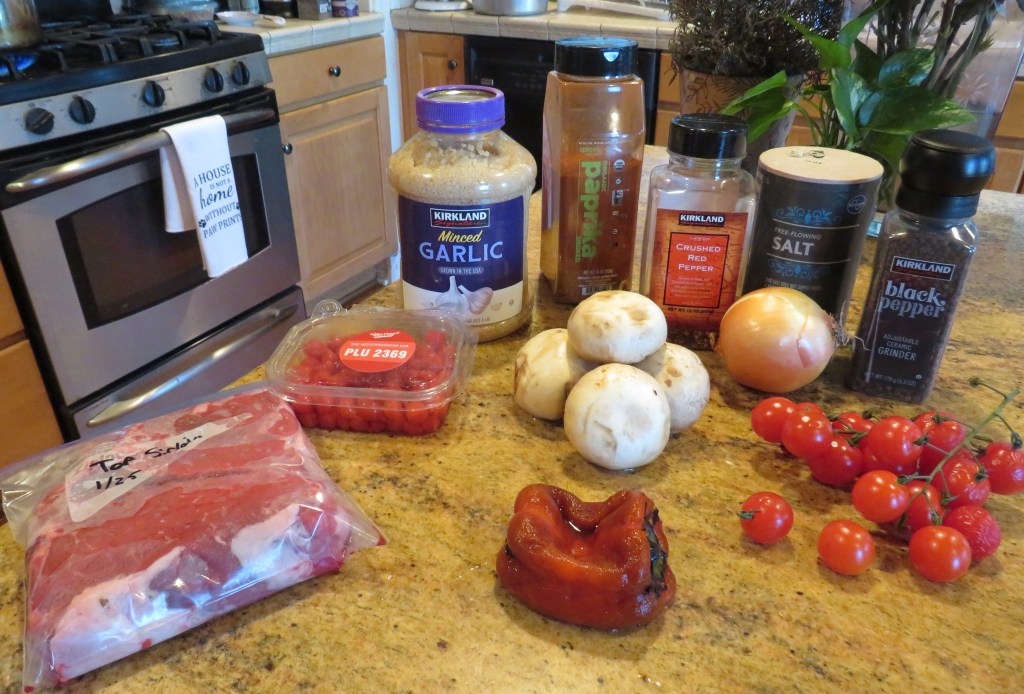
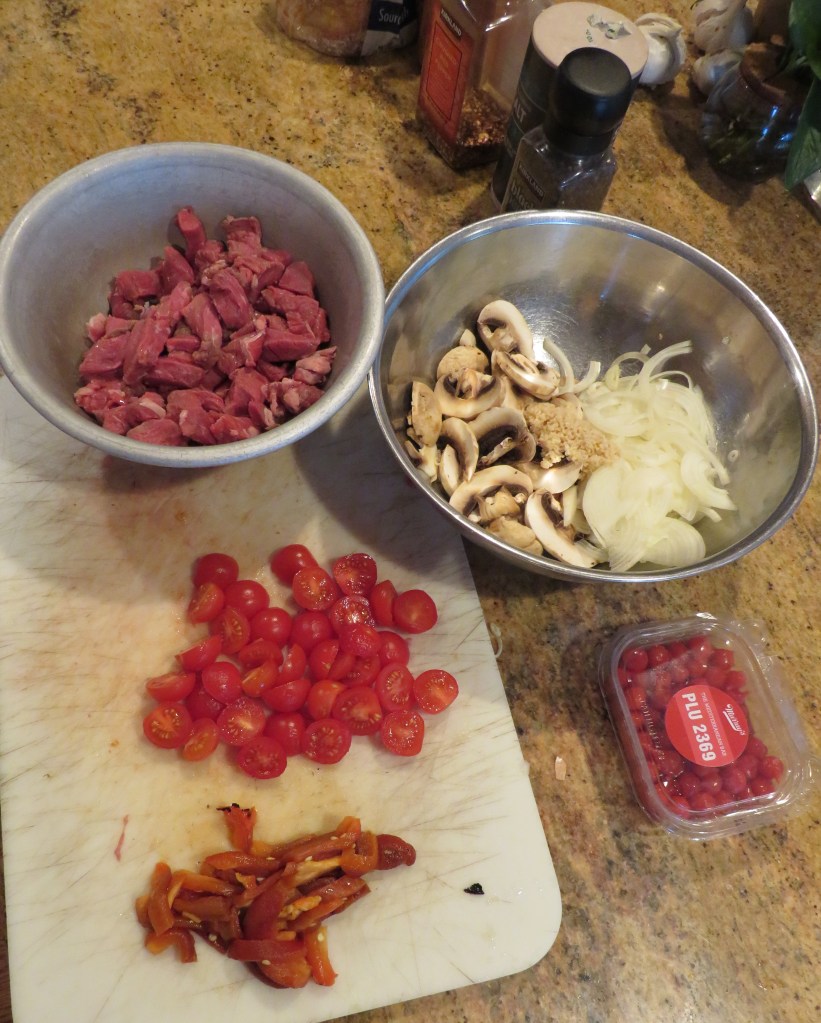
As the name implies, I added a variety of peppers to this dish. I of course used a fair amount of paprika, as well as black pepper, red pepper flakes, and then I added a roasted red pepper and some small, sweet Peruvian peppers too. And of course, there were onions and tomatoes added to the mix as well.
2-2 1/2 lbs meat, sliced into thin strips
1-2 TBSP garlic
1 onion, sliced very thin
1-1 1/2 cups tomatoes, diced – or smaller Campari tomatoes cut in half
4-6 mushrooms, sliced
1 roasted red bell pepper, cut into thin strips
1-2 cups chicken stock
1 cup dry red wine
salt & pepper to taste
flour to coat the meat
1-2 TBSP paprika
1-2 TBSP Peruvian peppers, optional
butter and olive oil to cook the meat
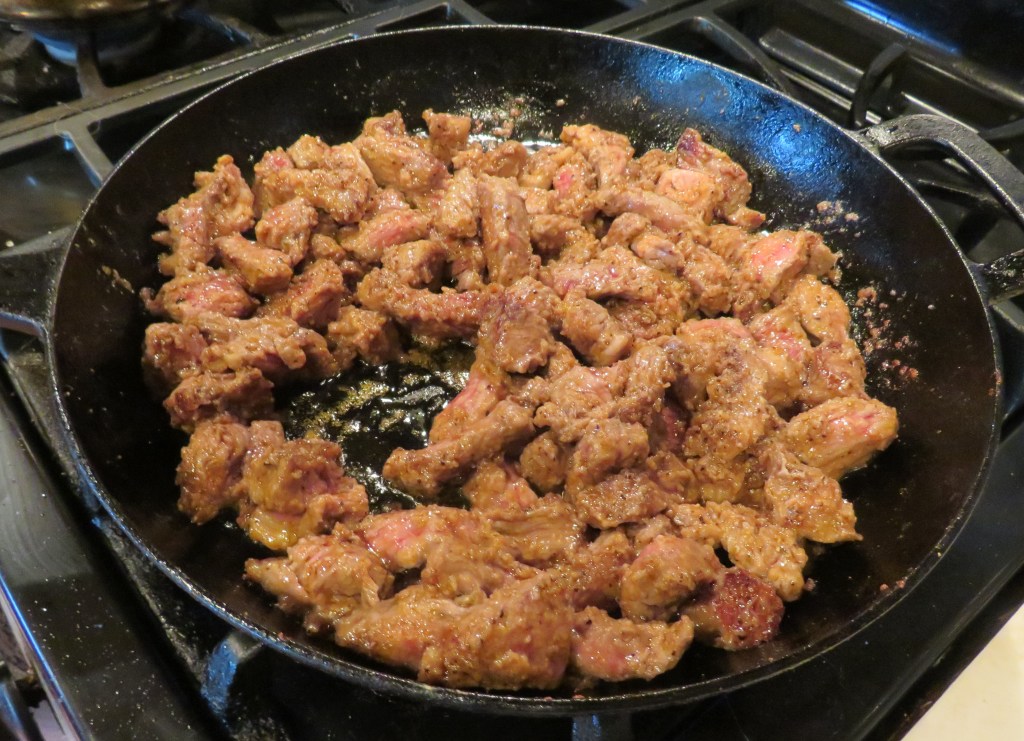
Coat the meat with salt, pepper, paprika and flour. Get a large skillet very hot, then add olive oil and butter and brown the meat completely. Once the meat is completely browned, remove it from the heat and set aside.
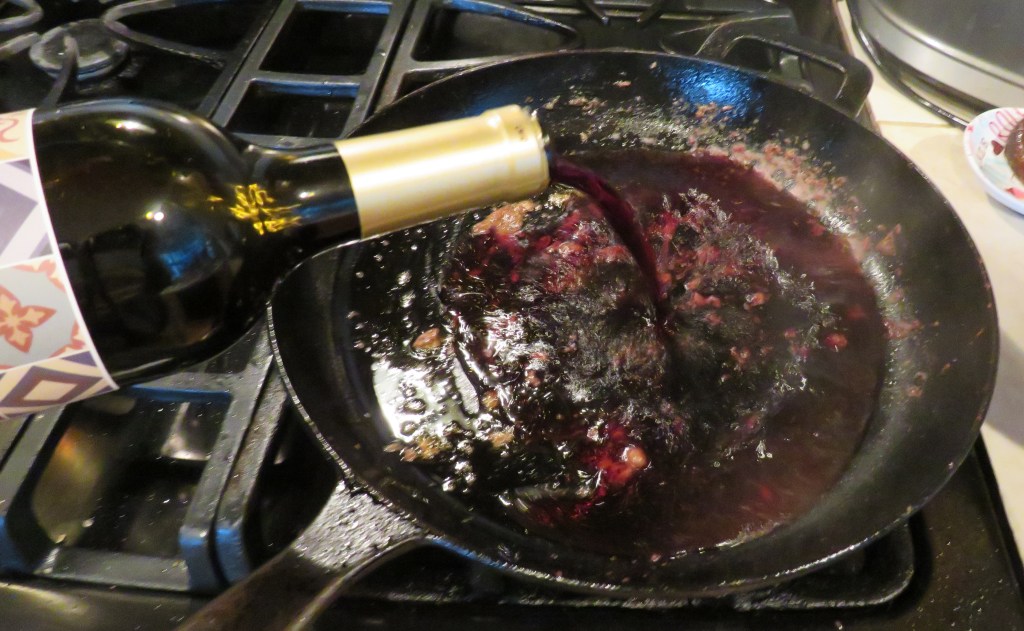
Deglaze the pan with the wine.
Add the mushrooms, onions and garlic and cook for about 2 minutes, or until softened.
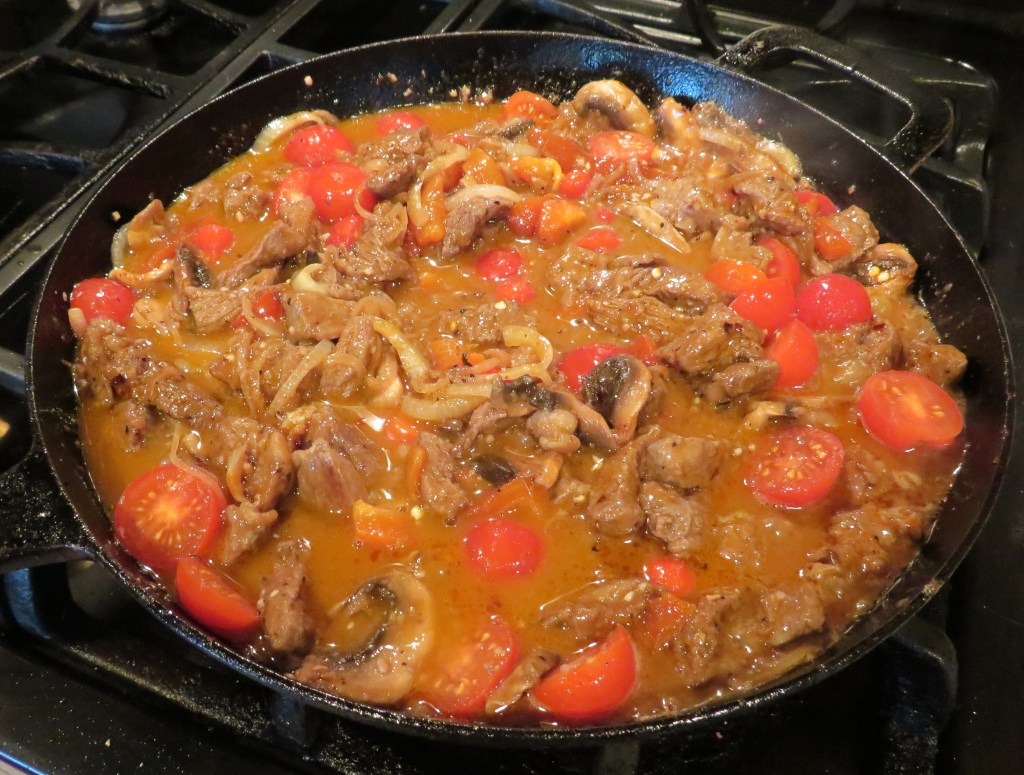
Add the chicken stock and mix together thoroughly. Then re-add the meat and the tomatoes and peppers, and adjust the seasonings as needed. Bring to a boil, then reduce the heat to a simmer and continue to cook for an additional 10-15 minutes, stirring frequently.
When everything is cooked, add to either mashed potatoes or cooked noodles, like wide egg noodles. I added some hot sourdough bread on the side, and the same dry red wine I used for the sauce. Delicious!
I always have a back-up plan. When things don’t go as planned for Plan A, switch to Plan B. Be creative and think on the fly. Have a great day and make everyday great. Stay safe and stay well. ‘Til next time.




















































 A Jeanne in the Kitchen