I have created this site to help people have fun in the kitchen. I write about enjoying life both in and out of my kitchen. Life is short! Make the most of it and enjoy!
I love my little Chickadees, but for some reason, they are hard for me to get good shots of. Maybe it’s because they are so fast and flit around constantly. But I will never stop trying. Every now and then I get some good shots of them. This was not one of those times, however, but at least they are decent. 🙂
It was a very cloudy, overcast day, so the bright colors of the Chickadee kind of faded into the gray background. He also was moving all around and did not want to sit still long enough for a good photo shoot. He was just teasing me. 🙂
This one is a stock photo to show you how beautiful these little birds really are when their colors are allowed to shine brightly.
Have a great day and make everyday a great day. Make the most out of what you are given. 🙂
April is one of our wackiest months of the year, weather wise. We are all over the place. One minute it is warm and sunny, the next it is snowing. Today, is just the 3rd day of April, and already, we are getting all kinds of weather. We are supposed to have more snow again tonight. Not a lot, but it is still supposed to snow.
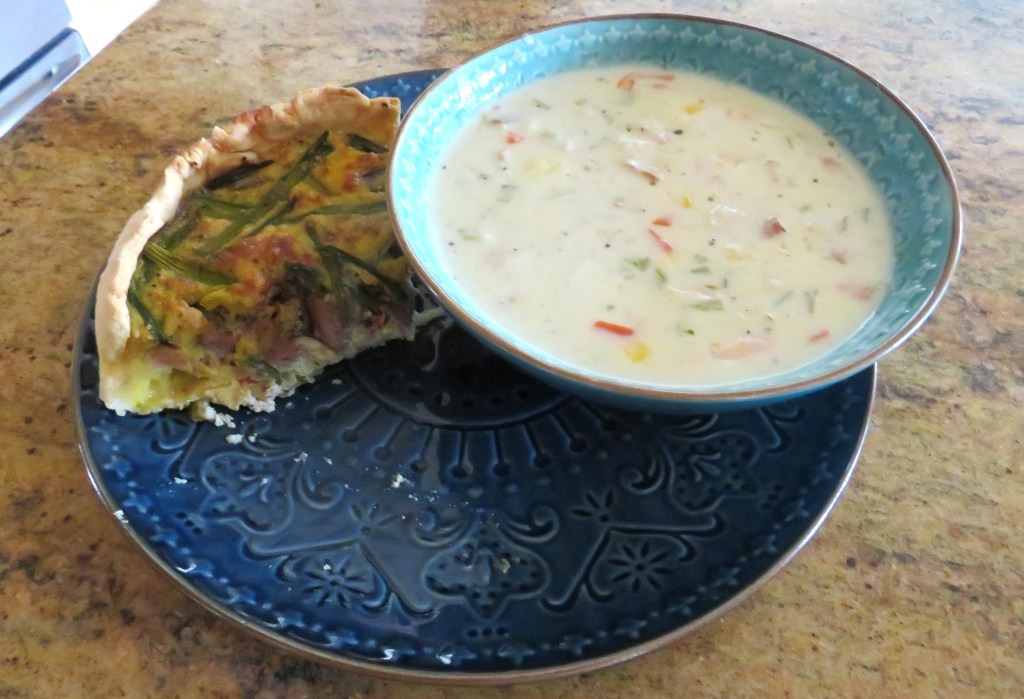
I cook according to what our weather is like. If it is warm, I will prepare something lighter to eat. If it is cold, I want something that will stick to our ribs a bit more. We are still getting more snow, and snow means I want something heartier for dinner. So I made a quiche with ham and vegetables. It was warm and straight from the oven. I served it with some hearty corn and chicken chowder. Both of these delicious options are great for colder weather.
I make quiches Another Quiche and soups all the time, and every time I make them they are a little different. It really kind of depends on what I have on hand at the time I am making them. My favorite soups are creamy soups with lots of stuff in them. Besides, in both cases, I am often using up my leftovers too. In fact, I used my leftover Moroccan chicken Moroccan Chicken for my soup. Back in my restaurant days, a lot of our soups were made from our leftovers from the day before.
Corn & Chicken Chowder
There are many different variations of chowders, and everyone has their own way of making them, but usually chowders are made with potatoes and bacon, and the rest is up to your imagination. I made a big pot of corn & chicken chowder.
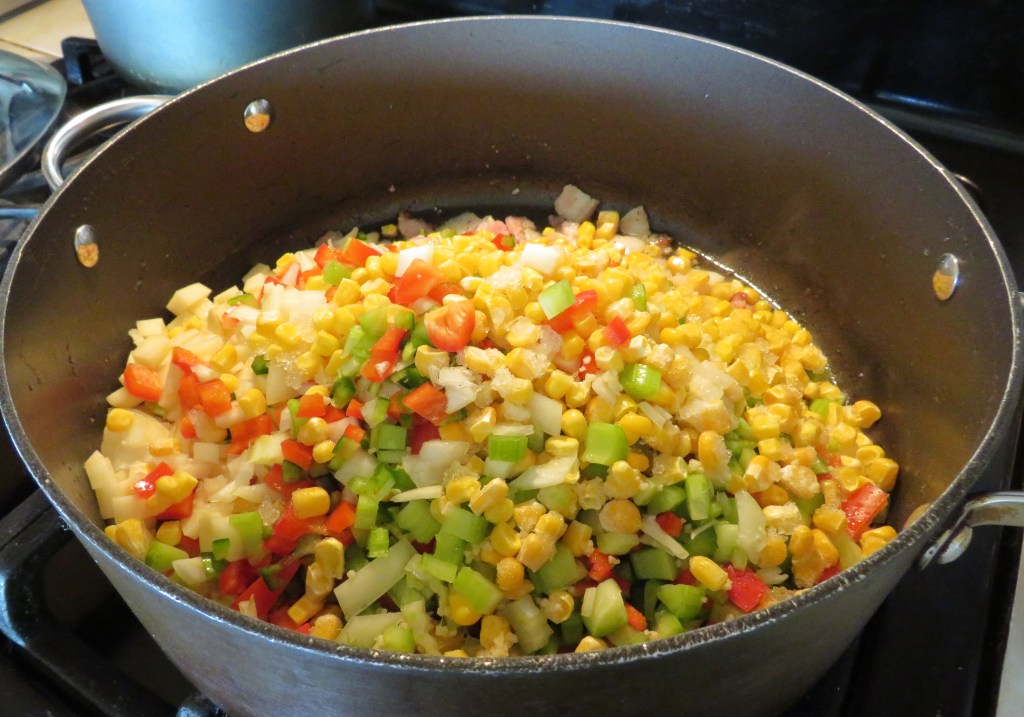
I made my chicken broth first, and while that was cooking, I cut up all my other ingredients.
1 1/2-2 pounds cooked chicken, cubed
6-7 slices of bacon, diced and cooked
2 large potatoes, diced
2 large celery ribs, diced
1 onion, diced
1 red bell pepper, diced
1-2 jalapenos, diced fine
2-2 1/2 cup corn
1 TBSP garlic
salt & pepper to taste
1 TBSP dried oregano
6-8 cups chicken broth or stock
2 cups heavy whipping cream
1-1 1/2 cups flour
Get a large soup pot very hot and add some olive oil, butter and the bacon. Cook the bacon to your liking, then add the celery, onions, bell pepper, jalapeno, corn and garlic. You can add the flour now if you like, to make it like a roux, or you can add it later. Just make sure the flour is completely mixed in and cooked before serving the soup. I added my flour to my vegetables to make it like a roux.
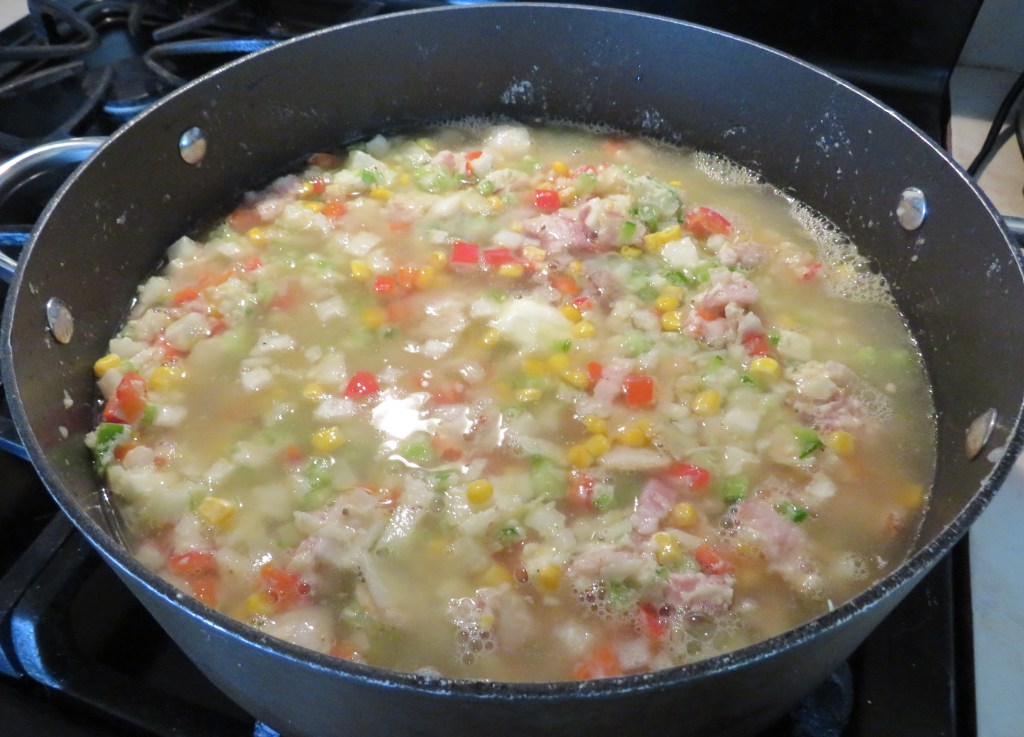
Cook until the vegetables have softened and the onions are translucent. Add the chicken, stock and seasonings and bring to a boil.
Reduce the heat to a simmer and add the cream. Cook for an additional 30-40 minutes, stirring often.
When it’s ready, serve it up nice and hot. Enjoy. To me, nothing says comfort food better than a nice hot soup filled with all kinds of vegetables and meats, and most importantly, lots of LOVE.
Have a great day and make everyday great. Stay safe and stay well. ‘Til next time.
My lakes have been popular with all kinds of birds these days. There was a crow on the rocks, at the water’s edge. He looked like he was enjoying himself too. I don’t usually see crows on the water. But I am used to seeing the unusual these days. 🙂
A few days ago, I gave you all a teaser, telling you I would once again be collaborating with Arlington Wines. Something In The Works Well, It is official now. Now I can share my article with you since it has been published on the Arlington Wines website. https://www.arlingtonwine.net/blog/cooking-with-wine. There will be yet another collaboration coming soon too. You will have to be patient a little longer, once again. 🙂 Thank you Ian and Arlington Wines, for allowing me to work with you. It is always a working with you. 🙂
Below is the article again. Enjoy!
Cooking With Wine
Cooking with wine is almost as old as cooking itself. People have been cooking with wine for 1000’s of years. Wine has been used as an ingredient in many recipes for many reasons over the centuries. Initially, in the ancient times, wine was healthier and cleaner than the water. People used wine and served wine with their foods in order to not get sick. But wine was also used in recipes to help preserve the foods, to enhance the flavors and the complexities of the foods and acted as a meat tenderizer. A grape concentrate called defruntum, which was unfermented grape juice, was also used before sugars were introduced to the old world. It was used to both sweeten and color foods, enhancing their appeal. Cooking with wine is, and was, found in every region of the world where wines are produced, but it was most prominently featured in foods from Europe, especially from France, Italy and Spain.
Archeologists have discovered evidence of wine being produced as far back as 6000 B.C. It is also believed that the “Cradle of Wine” was the region belonging to the Georgians, whose ancient ancestors discovered that burying grape juice underground for the winter turned it into something special. The grapes that were used by the Ancient Georgians were wild grapes. Evidence of the first actual wineries, where grapes were cultivated, was found in Ancient Armenia, at around 4100 B.C.
The first recorded history of wine being used for cooking comes from the Ancient Romans, in a cookbook from the 1st century, called De re coquinaria, or On Cooking. The Ancient Romans were known for using wine extensively in their cooking.
Today, cooking with wine is found everywhere, and it is used for many different purposes. Wine is used to marinate, macerate, saute, poach, boil, braise, stew, reduce or deglaze. Some cooks use wine for stir-fries, steaming or blanching. A splash of wine is an added flavor in many vinaigrettes and sauces too. Wine is used as a flavoring agent in countless recipes, since it adds more depth and complexity to a dish than water. Wine also adds acidity to foods, which helps break down the proteins and fats, making foods easier to digest.
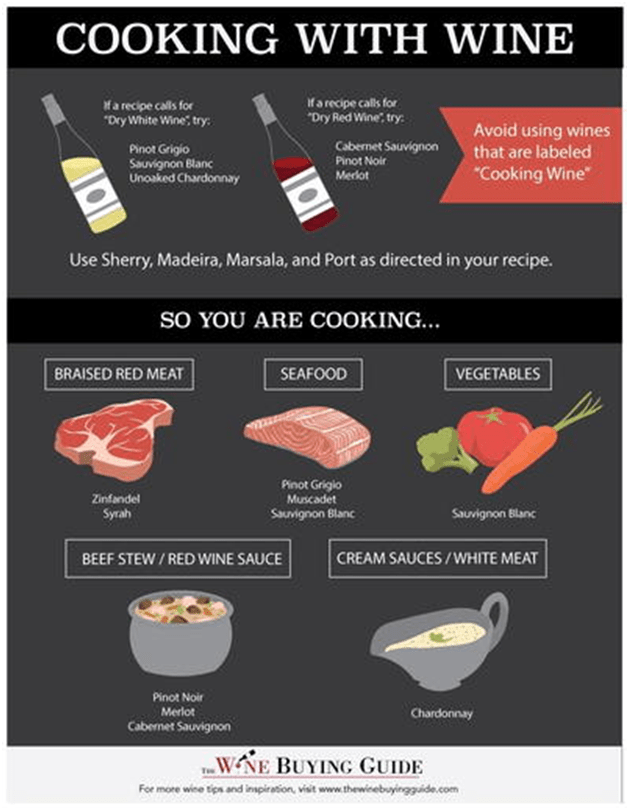
The possibilities of cooking with wine are endless. But don’t cook with cheap wines. If you are going to serve wine with the meal, use the same wines to cook with that you would serve with the meal. Another rule of thumb is to use the same guidelines when cooking with wines as you would for pairing wines and foods together for serving. As a general rule, red wines are for heartier red meats and lamb or for red sauces, such as a marinara sauce. White wines are used for lighter foods, chicken, fish and lighter sauces, such as a béarnaise sauce. Pork is one of those grey areas though, that either a red wine or a white wine will work well, but it depends more on the type of sauce you are using for the pork. You want to pair food and wine of similar weight and texture when cooking with wines. This helps balance out the recipe. If using wine for baking, generally a sweeter wine, such as a sweet Riesling or Gewürztraminer or a Moscato should be your wine of choice. Brandy and ports are also good choices for cooking purposes too, both sweet and savory. They too, will give a little sweetness and add a rich quality to the foods.
The alcohol content of the wines will lessen in the cooking process, but it depends on how you are cooking it. For instance, if you are deglazing a skillet with wine, more alcohol than water will evaporate, and there will not be as much alcohol content remaining. You will be left more with the essence of the wine than the wine itself. In general though, alcohol evaporates at a lower temperature than water – between 172-187*F, whereas water evaporates at 212*F. If you are using alcohol to flambé something, your dish will still contain roughly 75% of the alcohol, but if you are simmering a dish with wine it will only have about 25% of the alcohol content after 1 hour, and it lessons to only about 5% if it has been simmering for 2 ½ hours or more.
I cook with wine and alcohols all the time, and I even put them in my recipes too. 🙂
I use wine in my recipes for a wide variety of different dishes, in all kinds of ways. Just recently, I made Irish stew for St. Patrick’s Day and I used Guinness to give my sauce a rich, nutty taste. https://ajeanneinthekitchen.com/2020/03/18/irish-stew/I also made a Chateaubriand with a classic Bearnaise sauce, with a white wine base. https://ajeanneinthekitchen.com/2025/03/22/chateaubriand-with-bearnaise-sauce/These are just two of many, many recipes I prepare that include wine or alcohol. But as I mentioned above, the possibilities are endless.
I hope this article helps open your world of cooking to include wines for your recipes too. Don’t be afraid to experiment with wines when cooking, and yes, even using those wines for the recipes rather than just sampling purposes. Enjoy! Be creative! I have lots more fun recipes and ideas about cooking, food and wine just waiting to be discovered and shared.
Have a great day and make everyday great. Stay safe and stay well. ‘Til next time.
I just never know what I am going to see, or who I am going to meet when out on my walk-abouts. That is part of the charm. I love the unexpected surprises. This time, I was surprised with a female Downy Woodpecker, pecking away at the tree, looking for insects. I know she was a female because she did not have a patch of red on top of her head like the males do. She only let me get a couple of shots of her before flying off to another tree. But I am grateful for the shots she did allow me to get.
Always be prepared for the unexpected surprises life has in store for you. You just may be amazed at what you discover.
Duchess potatoes, sometimes known as Duchesse potatoes, are a classic French dish that dates back to the 18th century. These little potato puffs are cream-colored, soft and fluffy on the inside with a crispy golden crust on the outside.
The earliest written recipes for duchess potatoes, or “pommes de terre à la duchesse” in French, come from French cookbooks in the late 1700s. They were made by whipping mashed potatoes with egg yolks and then piping the mixture into balls or other shapes before baking. This gave the potatoes their signature light and airy interior encased in a crispy exterior. The potatoes were often served with meat dishes among the upper classes and for special occasions. Thanks to Downton Abbey Cooks at https://downtonabbeycooks.com/ for all this background information on Duchess potatoes.
Pommes duchess were named after the Duke and Duchess of Bourgogne, who were known for their love of fine dining and entertaining. According to legend, the dish was first created by the Duke’s personal chef, who was tasked with coming up with a new and impressive potato dish for a royal banquet. The chef decided to take mashed potatoes, which were already a popular dish at the time, and elevate them. By piping the mashed potatoes into decorative shapes and baking them until crispy, he created a dish that was both visually stunning and delicious.
We’ve been watching Antoinette, the story of Marie Antoinette, so I guess subconsciously my cooking was inspired by French royalty. 🙂 That and also seeing a recipe for Duchess potatoes from one of our very own. https://tasteoflesotho.com/
Duchess potatoes are not difficult to make at all, but they sure look and taste like they are. They look very elegant and they melt in your mouth with the soft interior and the crunchy exterior. They definitely have a royal air about them.
Duchess Potatoes
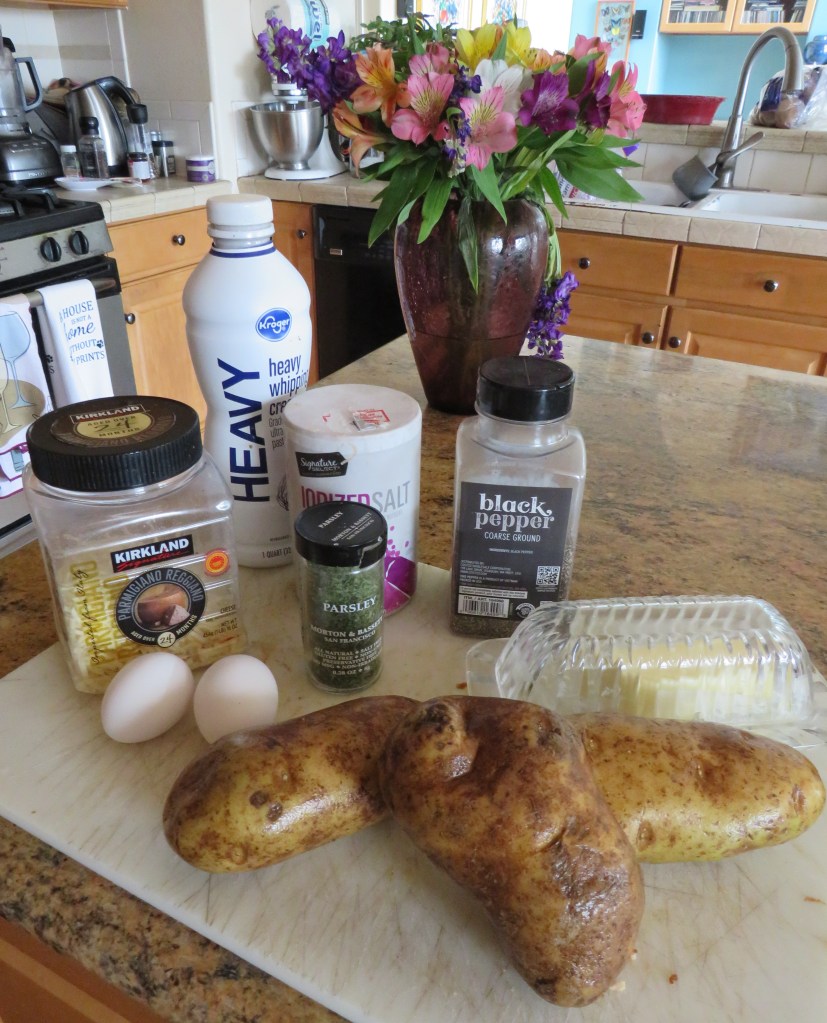
Yukon gold potatoes are what most people use because they naturally have a rich, creamy, buttery taste to them. But I used Russet potatoes this time, because that is what I had. They were every bit as rich and creamy using Russet potatoes as they would have been by using Yukon golds, but then when making mashed potatoes, I never skimp on either the cream or the butter. 🙂
2 lbs potatoes, rinsed, peeled and cubed
4-5 TBSP butter
1/2 heavy whipping cream, or more as needed
2 egg yolks
salt & pepper to taste
1/4 tsp nutmeg
1 cup shredded Parmigiano cheese
egg wash
chopped or dried parsley
Boil the potatoes for 15 minutes, then drain. Add the cream and the butter and mash the potatoes well. Make them smooth and creamy so you can pipe them through a piping bag.
Preheat the oven to 400*C or 200*C.
Combine the cheese, egg yolks and seasonings together and mix well. Then blend together with the mashed potatoes.
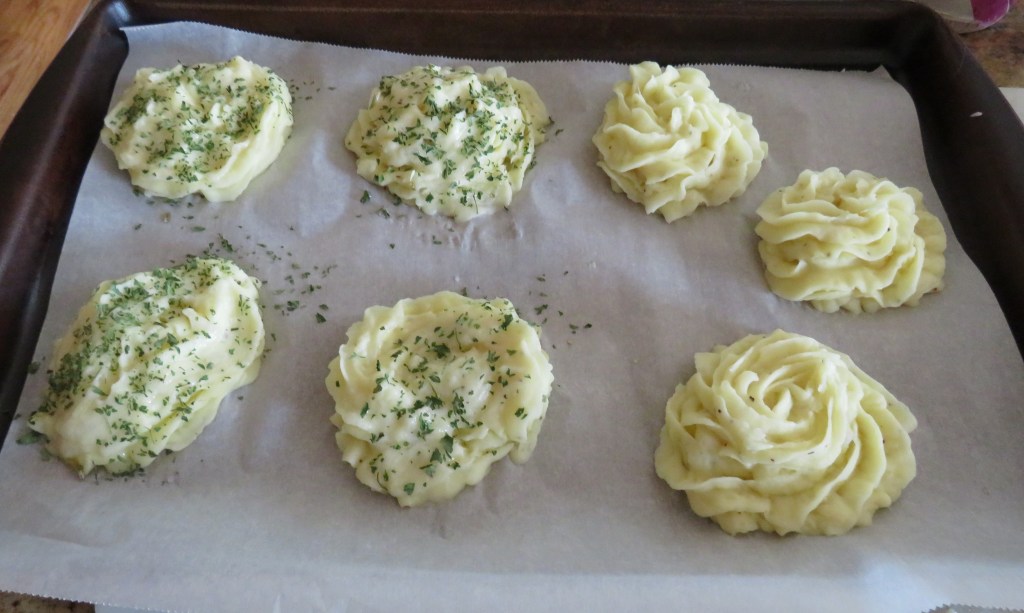
Once everything is mixed together, fill a piping bag with a scalloped tube and pipe the potato mixture onto a baking pan lined with parchment paper.
Make an egg wash using some of the egg whites and a dash of water. Gently pat the potato rounds with the egg wash, then sprinkle a little parsley on top.
Bake for about 25-30 minutes or until the potato rounds are golden and crispy on the outside. Serve hot. They will dress up any meat or main entree they are served with.
I served them alongside some chicken breasts with a Jamaican jerk sauce and some asparagus topped with red peppers, garlic and onion, with a cool, crisp chardonnay on the side. Delicious!
Have a great day and make everyday great. Stay safe and stay well. ‘Til next time.
Spring is definitely here. All my song birds are singing their love songs to each other. The other day, I caught some Red-Winged Blackbirds singing to each other. They sounded like they were so in love. But there is a twist. The lady bird was being courted by two males, both vying for her affections. Who had the best song? Who did she choose?
The males are brightly colored, with strong, vibrant patches of red, orange and yellow. The females are more subdued and not so brightly colored.
When I first started blogging, 7 years ago, (hard to believe it was that long ago) the Sunshine Blogger Awards were a big thing. Then they kind of faded away for awhile. But now they are back once again.
Some people don’t like them, but I think they are an honor. It means you are recognized and appreciated by both fellow bloggers and your readers. That being said, I was once again honored with yet another Sunshine Blogger Award, this time from fellow blogger, dog lover and friend, Thomas Wikman, from Leonberger Life at https://wordpress.com/reader/feeds/127844335. Thank you so much. I am very honored indeed.
Not only are these a badge of honor, but they are also a fun way to get to know one another better. We always learn something new.
Questions from Thomas to me:
What is my favorite movie?
My favorite movie is not one you would think of for a woman, but it is The Great Escape. I’ve probably seen it about 100 times. My dad and I used to watch it together all the time, and now I watch it when I am missing and thinking of my daddy.
What was my most unusual experience?
I don’t know really. Life is full of unusual experiences. I just take them all in stride and learn from them what I can, then move on.
What would I like to do that I haven’t done yet?
Sky dive. I have done the indoor skydiving a few times and I love it. We were all set for me to do a tandem skydiving adventure and then COVID came along and ruined everything. I still haven’t made new plans to do it.
What am I passionate about?
I am passionate about life in general. Of course, diving, cooking, dogs, cats and animals in general, are top of the list, but I am passionate about living life to the fullest. Larry and I do a very good job of living life to the fullest all the time. We are always up for new adventures.
If I could live anywhere in the world where would it be and why?
I am still trying to figure that out. I guess that means I have a lot more traveling left to do to help me figure that out. 🙂
What is my favorite way to spend my weekends or time off?
Traveling, going to new places, trying new adventures, diving, time with friends and family, cooking and entertaining for friends and family.
What do I want people to understand more about me?
I am insatiably curious, about everything, and I love to learn new things. Once I learn these new things, I love to share what I learn with others. Sadly, I am learning a lot of people don’t share this same curiosity and love of learning, which means they don’t always appreciate my findings, and my curiosities fall on deaf ears.
What is my favorite or go-to meal?
Anything pasta. Pasta is so versatile. I can dress it up anyway I like and it can always be something new.
Three people I would like to have dinner with, dead or alive?
Well, my daddy for sure, and of course my mom too. As for anyone else, that is a hard choice. There are so many people I would love to meet and talk to, on so many different topics. Once again, I am insatiably curious about everything and love to learn all I can.
What is the best piece of advice I ever received?
Never take myself too seriously. Always strive to be and do MY best.
What kind of music do I like?
I LOVE all kinds of music, as long as it is good music. What I listen to depends on my mood at the time. Music speaks to me in a lot of different ways.
I know you are supposed to pass this along to a few select people, but again, because I am naturally curious, I open it up to ANYONE and EVERYONE who would like to participate, with the same questions. They are good questions. 🙂 Anyone who puts forth the effort of writing a blog deserves to be recognized for their efforts, work and achievements.
Have a great day and make everyday great. Stay safe and stay well. ‘Til next time.
Yesterday, I wrote about nuts Going Nuts, which brought up some questions about various nut milks. So I looked into it and this is what I found.
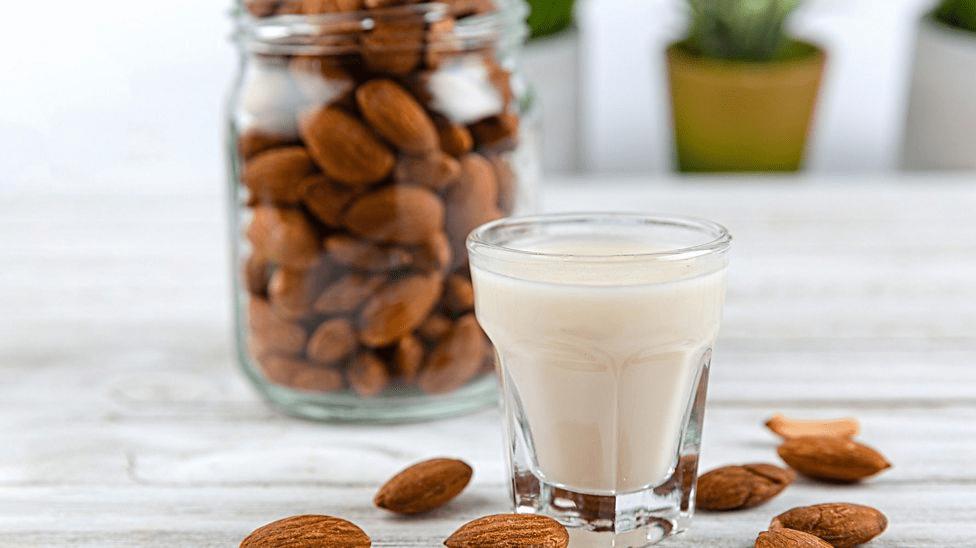
Various nut milks and other “milk” alternatives are very popular today. You can find them everywhere, and roughly 1/3 of consumers drink these milk alternatives for various reasons. Nut milks like almond milk, cashew milk, and other nut variations, are nothing new though. They have actually been around for roughly 1000 years. Regardless of the type of nuts being used, the process is the same. Raw nuts are soaked in water, typically overnight, to help break down hard-to-digest compounds and create a smoother, creamier texture. Then the soaked nuts are blended with fresh water until a smooth, creamy consistency is achieved. The blended mixture is strained through a fine-mesh nut milk bag or cheesecloth to remove the pulp. The commercial versions of nut milk almost always contain added flavorings and sweeteners, and other additives as well. Nut milks and other milk alternatives also contain a type of gum, such as guar gum, gellan gum, xanthan gum or locust bean gum. These are used in several types of foods – especially plant-based milks – to prevent separation, extend shelf life, or thicken the consistency.
Starting around the 8th century and through the Medieval times, people started drinking almond milk in hopes of reducing coughs and/or shortness of breath.
During the 13th and 14th centuries, almond milk in particular was an alternative to dairy products for those devout Christians who gave up drinking milk during Lent.
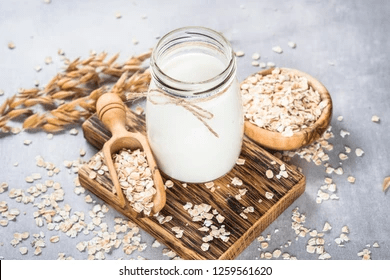
There are many different variations to milk alternatives. There is of course one of the most popular versions, almond milk, or other different nut milks, but there is also soy milk, coconut milk, oat milk, rice milk, hemp milk and even pea milk too.
Soy milk, like nut milks, has been around for hundreds of years. The use of soy milk dates back to the 1st-3rd centuries in China. The Chinese believed that soy milk was easier on the digestive system than cow’s milk. It originated in China, but did not become a global product until around 1910, when the first soy milk factory was built in Paris. Out of all the milk alternatives now available, soy and rice milk are the the healthiest versions, and are the ones closest to actual cow’s milk. Soy milk contains similar proteins and protein amounts as cow’s milk, and is usually fortified with calcium and vitamin D.
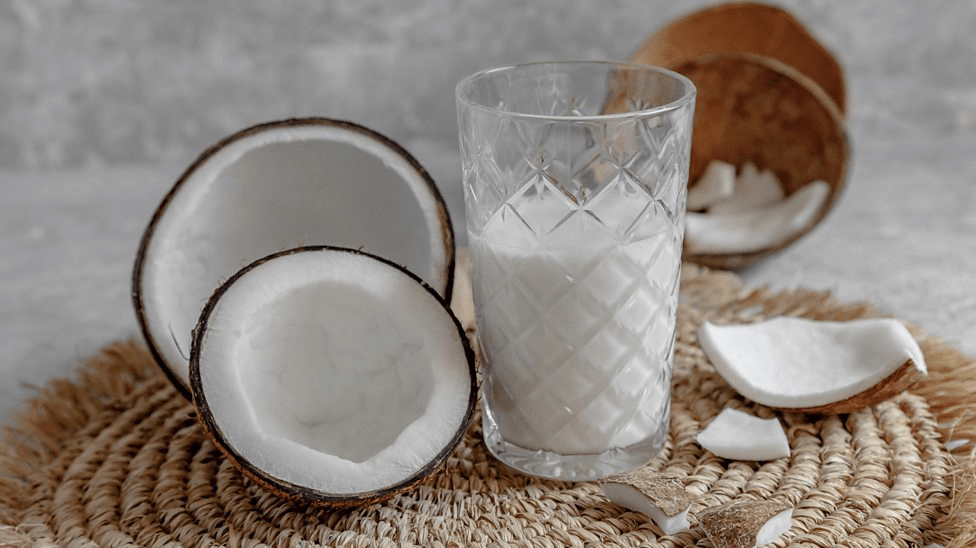
Coconut milk is another milk alternative choice. It has been around for about 5000 years. It is made through grating the coconut “meat” and mixing it with boiling water. It was a drink found in the Austronesian people, or the people from places such as Madagascar, Maritime Southeast Asia and the Oceanic island regions. The drink itself began to be more widely used around 2,000 years ago, in particular in India and Southeast Asia – where it was not only drunk but used as an essential ingredient in cooking.
Rice milk is another popular choice. It is made from rice, typically brown rice, and may be sweetened and flavored. Rice milk is naturally sweet and has a mild, slightly creamy flavor. Commercial rice milk is typically manufactured by using brown rice and brown rice syrup, and may be sweetened using sugar or sugar substitutes, and flavored by other common ingredients, such as vanilla. Compared to cow’s milk, rice milk is lower in protein and fat, but higher in carbohydrates and sugars.
There is also oat milk. This is a newer version of a milk alternative. It was created in Sweden in the 1990’s, by Swedish food scientist Rickard Öste. He was researching lactose intolerance and wondered whether an entirely new milk product would be viable. Öste developed an oat-based alternative, taking advantage of a large supply of oat crops in Sweden. He used enzymes to convert the oats into a rich, milk-like drink, adding plant-based oils to provide varying levels of fat, to mimic cow’s milk. Oat is not the best choice in comparison to other non-dairy alternatives though. It’s relatively high in sugar and most brands are ultra processed, containing additives that are not supportive for optimal health.
Hemp milk is also making waves and generating interest these days. Hemp milk is a non-dairy beverage made by blending water and seeds from the hemp (Cannabis sativa) plant. It has an earthy, nutty flavor and a creamy consistency. Hemp milk is an excellent option not just for those avoiding dairy, but also for those with tree nut allergies. But like with any of the other milk alternatives, there are both pros and cons. Some brands of hemp milk have added sugars. Too many added sugars may increase your risk of diabetes. Some hemp milk also contains thickeners like carrageenan, guar gum, or xanthan gum. These gelling agents may cause stomach aches, bloating, inflammation of the digestive system, and more adverse reactions. People who take anticoagulants or other types of heart medications should speak to their doctor before taking hemp seeds. So should people with gastric problems.
And yet another milk alternative choice is pea milk. It’s actually made from yellow split peas, which mostly grow in Southern Europe, North Africa and Asia. Unlike a lot of nut milks, the peas aren’t usually soaked in water to produce the liquid. Instead, they are milled into flour and then processed to separate the protein from the fiber and starch. Pea milk is a new invention, and has only been available, primarily in the UK, since 2019.
And the latest milk craze is to make “milk” out of potatoes. This is a brand new creation, having only been started about 3 years ago.
Almond or Other Nut Milks: A popular choice, naturally low in calories and often fortified with calcium and vitamin D, but lower in protein and fiber compared to other plant-based milk is almond milk. Typically nut milks are high in fat and calories, but they’re also high in essential nutrients, like iron and vitamins E and D (if they’ve been fortified). These milk options aren’t right for everyone.
Soy and Rice Milk: Are good sources of protein, comparable to cow’s milk, and contain prebiotic fiber that can promote the growth of beneficial gut bacteria. Soy milk is also a source of isoflavones, compounds with potential anti-inflammatory and digestive benefits. However, some people may have soy allergies or sensitivities, so it’s essential to consider individual tolerances. Rice milk usually contains a lot more sugars than dairy milk.
Oat Milk: Well-tolerated by those with lactose intolerance, and oats contain beta-glucans, a type of soluble fiber that can support gut health. Oat milk is also naturally sweet, so it’s essential to opt for unsweetened varieties if you’re watching your sugar intake.
Coconut Milk: Can be nutrient-rich and support a healthy inflammatory response, but it is very rich, and is a strong laxative.
I know people who drink these milk alternatives all have their own specific reasons for doing so, and that’s fine. Some people think they are helping the environment by using these milk alternatives, but they usually require a lot of water to produce, and are very time consuming and labor intensive to make. Some people think these milk alternatives are healthier than cow’s or goat milk, but know that they are all still processed, and most contain added sweeteners and flavorings and other additives as well, which also adds a lot more calories and sugars. If you choose to use milk alternatives, do your research and find what is the best option for you. They are not all created equal and they are not the same. If you can handle it, the healthiest, purest milks to drink are real milk, whether it be cow’s milk or goat milk.
I hope this has been informative and helpful. Have a great day and make everyday great. Stay safe and stay well. ‘Til next time.
Colorful spring flowers are popping up all over the place. As usual, my yellows, whites and purples are the first to spring up. They look so happy and pretty. They have been waiting to come up all winter, and now they are here.




































 A Jeanne in the Kitchen