Gnocchi with Chicken, Vegetables and Pesto

Dumplings are found all over the world, especially in the colder climates.  They are usually made with potatoes, but they can also be made with a variety of other ingredients too.  Gnocchi are the Italian version of these potato dumplings.  It is believed that potato gnocchi were first created in Northern Italy sometime during the 16 & 17th centuries, after the Spanish explorers brought the potato back to Europe from their explorations in South America, although gnocchi of different variations were popular as menu items for banquets and feasts during the Renaissance period, which was much earlier.

Gnocchi, as we know them today, were created in Northern Italy, where the climate is cooler than it is in Southern Italy.  The cooler climate is much better for growing and producing potatoes than it is for grain.  Though they are mostly made from potatoes, they can also be made with other root vegetables, spinach and sweet potatoes too, as well as semolina and other ingredients.

The word gnocchi is believed to have been derived from two words.  The first is nocca, which is the Italian word for knuckles, and the second is knohha, which is the Lombard word for knot.  Both are plausible, since both words refer to the small, tight, rounded dumplings we know and love as gnocca, or the plural, gnocchi.

I love gnocchi, but I was always a little intimidated to make it.  I was always waiting for someone to “show me how to make them”, though that never happened.  But as with most things, I easily taught myself how to make them and the rest is now history.  They are actually pretty easy to make and are not nearly as intimidating as I first thought.


My gnocchi dish was loosely, very loosely I might add,  inspired by this gnocchi dish from my “Flavours of Urban Melbourne Cookbook” that I received as a Christmas gift from my nephew and his wife a few years ago.  I completely changed it and made it my own, which is just what I do.  I had a few of Priscilla’s Parmigiano savory cookies left too, A Simple Celebration which was a nice accompaniment to the gnocchi.  I made my dish with chicken, added more vegetables and pesto sauce.  It was very tasty indeed.  And the Queen would be so proud of me for creatively using more leftovers too.  These gnocchi  are made from mashed potatoes, and I had some leftover mashed potatoes from the other night.  Perfect.

IMG_0231

Gnocchi with Chicken, Vegetables and Pesto

2 lbs chicken, cut into strips

1 yellow or crookneck squash, sliced thin

1 zucchini, sliced thin

1 shallot, sliced very thin

1 1/2 cups mushrooms, sliced

1 cup tomatoes – I used the yellow sun tomatoes, cut in 1/2

olive oil

salt & pepper to taste


IMG_0221

Gnocchi

1 1/2- cups cooked and cooled mashed potatoes

2 cups flour

1 egg


Mix the mashed potatoes, flour and egg together and knead until it becomes a ball.  Break off equal parts and form into smaller balls and roll on a smooth surface until they become long, snake-like tubes.  Then cut into small pieces about 1 inch in size.

IMG_0222

IMG_0223

When the gnocchi are all made, place them on a baking sheet lined with parchment paper and place in the refrigerator while preparing the rest of the dish.

IMG_0224

If you are making your own pesto, Pesto Pasta Primavera with Chicken and Vegetables prepare it in the food processor and set aside.

Slice your vegetables and cut the chicken.

Saute the vegetables in the olive oil along with the salt & pepper.  For those of your garlic lovers out there, fear not!  There is plenty of garlic in here already.  I always add garlic to my mashed potatoes, so the gnocchi already have garlic in them, AND I am very generous with my garlic when I make my pesto.  believe me, this dish has plenty of garlic.  No need for more.  So, I purposely left it out of my vegetables, not to over power the dish with garlic.

IMG_0225

IMG_0227

When the vegetables are cooked, remove them from the skillet and set aside.  Add the  chicken and cook it until it is fully cooked.  When the chicken is fully cooked, add the vegetables back to the skillet and combine well.

IMG_0229

While the vegetables and chicken are cooking, start a large pot of water to boil.  Once it starts to boil at a rapid boil, add the gnocchi.  You may need to make a few batches.  Let them boil for about 4-5 minutes, or until they float at the surface.  When they float, they are done and are ready to eat.

IMG_0230

When the gnocchi are done, plate everything up.  I like to layer my foods.  It makes for a much better presentation.  So I started with my gnocchi, added a little pesto, then the chicken and vegetables mixture, with more pesto on top.  Then I added just a few tomatoes at the very end.  I also served this with some warmed ciabiatta and white wine to make a perfect Northern Italian dinner.  Mangia!

IMG_0232


The Things They’ve Been Saying

I admit, I have not been as busy in the kitchen as usual lately.  Things have just been very busy and very chaotic.   Everything is getting back to normal once again, however, which means, the kitchen will soon be in full swing once more very soon.  When the kitchen slows down, I “listen” to the advice of others and share that advice with all of you.  Here are some good words of kitchen wisdom I hope you all enjoy.


If more of us valued food and cheer and song above hoarded gold, it would be a merrier world.

~ J.R.R. Tolkien, Author of Lord of the Rings and the Hobbit ~


One of the very nicest things about life is the way we must regularly stop whatever it is we are doing and devote attention to eating.

~ Luciano Pavarotti, Italian Opera Star ~


After a good dinner one can forgive anybody, even one’s own relatives.

~ Oscar Wilde, British Author of The Portrait of Dorian Gray ~


Food is symbolic of love when words are inadequate.

~ Dr. Alan. D. Wolfelt, author, educator and grief counselor


People who love to eat are always the best people.

~ Julia Child, Cookbook Author and Chef and Culinary Pioneer ~


Nothing brings people together like a generous spread of food.  It’s the universal unifier.  Food serves as a cultural marker, attends every milestone and celebration, and can be dressed up or down.  Food is where the heart is.


A Golden Celebration

Our friends Janet and Bob just celebrated their 50th wedding anniversary.  We are very honored to have been apart of their special celebration.  For those of us who are married, we all know it can be full of trials and tribulations, and to make it for 50 years is really quite an accomplishment.  Congratulations Janet and Bob!

IMG_0216

Janet and Bob chose to celebrate their big day at Root Down, a fun and hip restaurant in Denver.  Root Down is one of 6 restaurants in the same “family” that are all known for being “renegades of flavors and masters of remix”.  All 6 of these restaurant siblings are also known for serving “responsibly-grown and innovatively simple sourced foods that are veggie-forward” (sic).  The other restaurant “siblings” include the first restaurant in the family, Edible Beats, that was started in 2008.  From there, it grew to include Linger, Ophelia’s, Vital Root, El Five, and 2 Root Downs, one in Denver (the one we dined at) and the other at Denver International Airport (DIA).

IMG_0190

IMG_0193

There were 8 of us in the celebration party.  We all decided the best way to sample as much as possible was to order small plates and share.  We all got to taste and enjoy quite a few different menu items this way.

IMG_0192

As we were waiting for our food to arrive, we were all given a small little “palate cleanser” with a dollup of goat cheese, spicy beets and beans.  It was zesty and quite refreshing, as well as being a fun way to start the meal.

IMG_0201

The menu selections.

IMG_0195

And the food arrives.

IMG_0203

We all started with either soups or salads.  This soup was the sunchoke soup with spinach pesto.   The other soup choice at the table was a carrot and red curry soup with an apple-ginger chutney.  Both soups were very good.

We also chose two bottles of wine from our very own Bookcliff Vineyards, located in Boulder.    We had the 2017 Ensemble Red and the 2018 Viognier.  We also just happened to be dining with the owners of Bookcliff Vineyards, John and Ulla, who are dear friends of Janet and Bob.  Our waiter was very cute, and was also a bit surprised to be serving the owners of the winery.  That is not something that happens everyday, that’s for sure.

IMG_0212

We all shared bits and pieces of a wide variety of dishes.  These are the lamb sliders with sweet potato fries and a lime cilantro dipping sauce.  I will most definitely be making these in the near future.  They were delicious!

IMG_0205

The flavorful flank steak.

IMG_0206

The crab and avocado tacos with the “tortillas” made from very thinly sliced jicama.  This was definitely something very new for me.  I never would have thought of that.

IMG_0208

And the scallops.  These were cooked to perfection and served on top of a bean patty with delicate cream sauce.  Fabulous!

IMG_0209

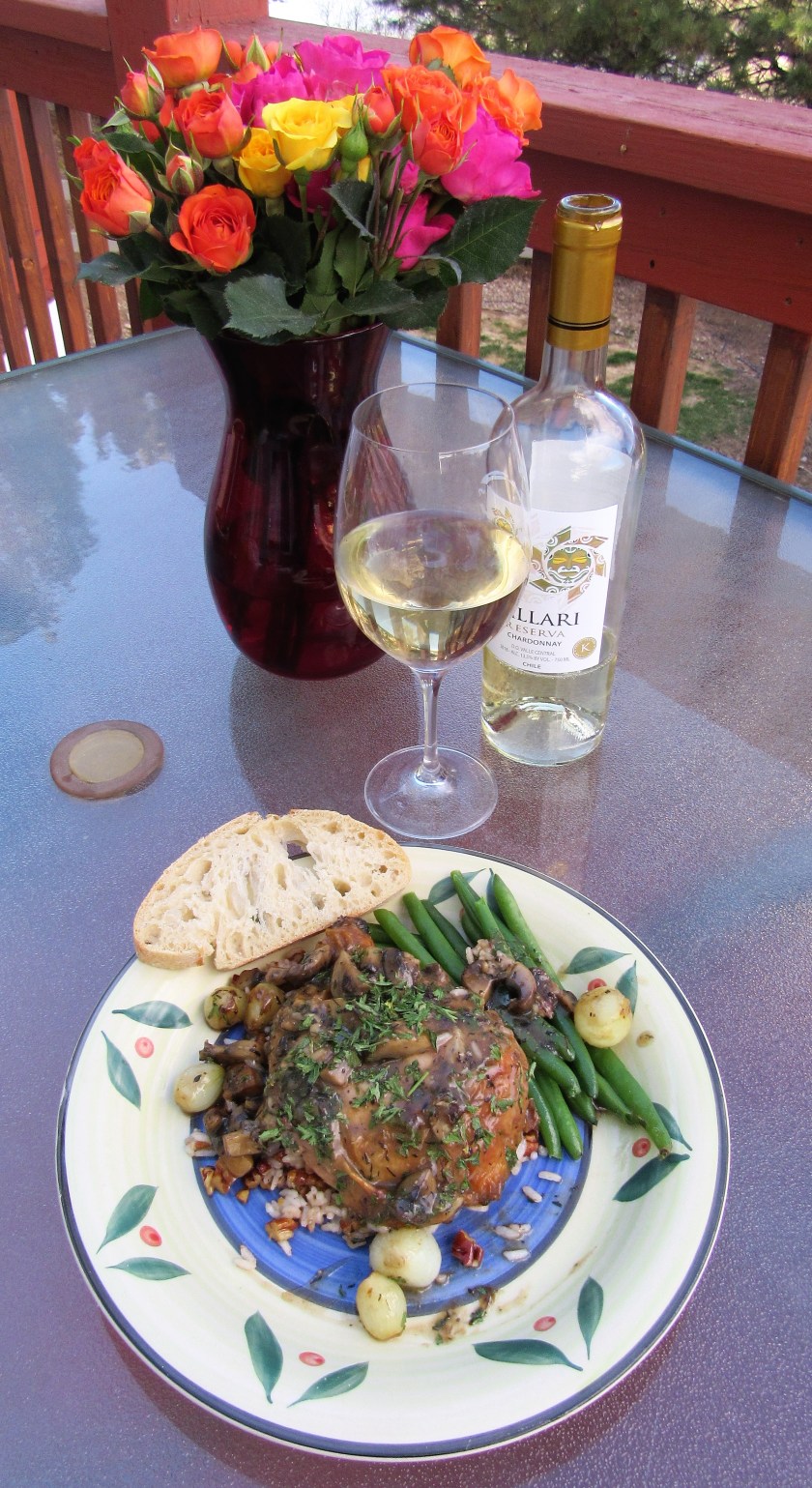
Once were done eating and our tummies were full, we were all treated to a bit of the bubbly from Inga Veiss, the Asst. General Manager and the staff, in celebration of Janet and Bob’s major lifetime achievement.  A toast to the happy couple.
IMG_0210

Inga also gave me a cookbook with recipes from all their restaurants, which I gave to Janet as yet another memento for the occasion.

IMG_0213

Our entire experience at Root Down was incredible.  The food, the staff, the ambiance; everything was orchestrated perfectly to make for a fabulous celebration.  A good time was definitely had by all.  Thank you.   Root Down is located at 1600 West 33rd Avenue, Denver, CO 9-80211.  You can contact them by phone at (773) 829-1463 or by finding them online at ROOTDOWNDENVER.COM.

After leaving the restaurant, we all headed back to Janet and Bob’s for another champagne toast and some dessert.

IMG_0214

Happy 50th Anniversary Janet and Bob.  May your love for each other continue to grow.

IMG_0218


Pasta with Creamy Ham and Vegetable Sauce

We eat a lot of pasta dishes in our house.  It is very versatile and can be cooked with anything.  You can eat it hot or cold, with any kind of sauce, any kind of meat and any kind of vegetables, or any combination thereof.  To me, pasta is the perfect food that is perfect for any meal and any occasion.  You can dress it up or dress it down and either way, it will always be a winner.  Pasta is a dish that is considered universal comfort food no matter where you live or what your background.  Pasta is very easy to make as well, with only a few basic ingredients.  The basic recipe for making pasta really has not changed much at all through the centuries either.  All you need to make the basic pasta recipe is flour, salt, 1 egg and water.  Anything else is just extra.   I do know how to make my own pasta, and yes, I have done it, but why?  There are so many great pastas available to purchase, so it just doesn’t make sense to make my own, especially since time is always against me.   Once you’ve made your basic pasta, you can cut it and shape it however you like.

When we think of pasta dishes, we tend to think of Italian dishes.  But pasta was actually introduced to Europe back in the days of Marco Polo, when he came back from China and Asia, in the 13th century.  Today, every almost country has their own version of pasta.  In Germany and Hungary they have spaetzle.  In Greeze, orzo. In Poland, they enjoy pocket-like pierogi.  Ashkenazi Jewish families make kreplach dumplings, and these are just some of the many wonderful things you can create with pasta.  The only thing to limit your creations is your imagination.  The word pasta is an Italian word that means paste, which is another reason why we tend to think of it as an Italian delicacy, but the basic ingredients are found everywhere in the world and used in every culture, and has been pretty much since the beginning of time.  Here in America, it was actually Thomas Jefferson who first introduced pasta to the States, but it really became popular in the late 19th century with the influx of Italian, German, Polish and Jewish immigrants who ate some form of pasta as a dietary staple.

As I mentioned above, we eat a lot of pasta.  So, not only do I make the traditional pasta dishes we all known and love, but I am always creating something different too.  This time, I was once again visited by the Queen of Leftovers, and was trying to be creative.  I used my leftover pasta and ham that we took out of the freezer from the holidays and mixed them with vegetables and a creamy Alfredo Sauce.  Christmas Eve Celebrations 

IMG_0145

Like with most things I make, there is no real set recipe, and as always, use what you like and leave out what you don’t like.  I loaded mine up with vegetables because I LOVE all kinds of vegetables.  I honestly can’t think of any vegetables I do not like, so we eat a wide variety, all the time.  Often times I am really just trying to be creative with the bits and pieces I have leftover from other meals.

Pasta with Creamy Ham and Vegetable Sauce

IMG_01361 1/2 lbs cooked ham, cut into strips

1 cup mushrooms, sliced

1 shallot, sliced very thin

1/2 crookneck or yellow squash, sliced

1/4 red bell pepper, sliced thin

1 cup frozen peas

2 cups spinach stems removed and chiffonade, or cut into thin strips

1 TBSP garlic

olive oil

salt & pepper to taste

1 tsp each, dried thyme and sage

1/2 cup dry white wine

1-1 1/2 cups heavy whipping cream

1/4-1/2 cup shredded Mozarella cheese


Saute the vegetables, except the spinach, garlic and seasonings in the olive oil until the peppers are tender and the shallots are translucent.  Then remove the vegetables and set aside.

IMG_0139

Add the wine to the skillet, bring to a boil, and let cook for about 1-2 minutes, or until the liquid has been reduced to about 1/2.

IMG_0140

Then add the cream and the cheese and mix together thoroughly.

IMG_0141

IMG_0142

Once the sauce is mixed together, add the vegetables, ham and spinach, and combine everything together well.

IMG_0144

Once everything is blended together and the sauce is done, serve it over your favorite pasta and enjoy with some warm bread and the same wine you used for your sauce.  And dinner is served.  Mangia!

IMG_0146


Bavarian Goulash

Goulash is a beef and vegetable stew that has been a main staple of many European countries since around the 9th century.  It is a staple in the diets of Hungarians, Germans, and many of the Slovic counties.  Hungry for Hungarian  Sometimes you will hear goulash referred to as Hungarian goulash and other times, as Bavarian goulash, but they are basically the same dish, with various regional differences.  It is a hearty stew made with meats and hearty vegetables.   Hearty vegetables are the only vegetables that are suitable for the harsh, rural conditions and cold climates of these regions.  There are many dishes from these areas that are made from either potatoes or beets, since both are staples in the German, Bavarian, and Hungarian diets.   Goulash is never eaten on its own.  It is always served with either potatoes, noodles, dumplings or rice.

IMG_0179

Today, Bavaria is part of Southwest Germany, and has been so, officially, since 1949.  Bavaria is the largest of Germany’s 16 states or Bundeslands.  It comprises 1/5 of the total land mass of Germany.  Before this time, however, the Bavarian borders have shifted and switched allegiances to different countries many times through out the centuries, and its beginnings, back in the 1st century BC, when is was occupied by the Roman Empire.  Bavaria was even it’s own country for a brief time.  Bavaria is located 157.7 miles or 129 km from Munich and 494 miles from Hungary.  Bavaria, Germany and Hungary all share a long history, with many similarities and traditions.

Bavarian Goulash

IMG_0170


1/4 cup oil, butter, or a combination

2 lbs lean beef, cubed

1 large onion, medium dice

1 green bell pepper, medium dice

2 large tomatoes, medium dice

salt & pepper to taste

3-4 TBSP flour

1 TBSP garlic

2 tsp paprika

2 bay leaves

2 cups beef broth

1/2 cup red wine

1 cup mushrooms, sliced


IMG_0172

Mix the flour, salt and pepper together and coat the meat with it.

In a skillet with the oil/butter combination, saute the vegetables and garlic until the onions are translucent and the peppers are tender.  Then remove from the pan and set aside.

IMG_0173

Add more oil and/or butter to the skillet, then add the meat and brown completely.  Stir frequently so the meat and flour do not burn or stick.

IMG_0174

When the meat is cooked, add the vegetables back into the skillet.  Mix the beef stock, wine and bay leaves together and pour over the meat and vegetables.

IMG_0175

Mix everything together well, then add the paprika and tomatoes and thoroughly combine everything together.  Cook at a medium heat for about 20-30 minutes, or until the sauce thickens, stirring frequently.

IMG_0177

When the sauce has thickened and the goulash is ready, remove the bay leaves and discard them.  Serve the goulash over your choice of potatoes, dumplings, noodles, or rice.  I served it over creamy mashed potatoes.

IMG_0178

Complete the meal with some good bread and a nice red wine to make a perfect warm meal on a cold and chilly night.  Wundebar!

IMG_0180


Another Present in the Mail

This week is definitely ending on a very good note.  Two presents in two days.  It’s not even Christmas or my birthday.  These are just because presents.  Those are the best.  🙂 Today’s present is a book from our very own “Goldie”.  It’s  called Static Dreams, Volume 2.  I am so excited to read this book.

IMG_0187

If you don’t follow Goldie’s blogs, you should.  She has very good insight and information on a wide range of topics.  Though Goldie and I have never met in person, yet, I feel like I have known her for years.  I have come to rely on her as a my editor and second set of eyes, but more so, I am honored to call her my friend.  And WE WILL meet one day, which I just know will be the start of an even better friendship.  You can see what Goldie is up to and what’s on her mind at https://dailyflabbergast.wordpress.com/,  and by following her special categorical blogs NROP or News Related Opinion Piece, CW or Creative Writing, BT or Blogging Tips, HW or Hashtag Week, and Awards.   Goldie is one busy bee, as you can see, and yet she still finds time to write books as well.  She is amazing!  We all need more Goldies in our lives.  I’m just glad I have this one in mine.  🙂  To borrow your phrase Goldie, “stay golden”.

A Surprise in Today’s Mail

As we all know, sadly, the holiday season of 2019 has come and gone.  We are now into a new year and a new decade.  But that doesn’t mean presents aren’t still loved and greatly appreciated.  I love presents anytime.  🙂  I received a surprise present in today’s mail, from my friend Karen, in San Diego, CA.  It totally made my day.   I was feeling a little wiped out after an event that happened at work this morning and was just really kind of in a bit of a funk.  It really knocked my socks off.  So getting this surprise today really perked me up.  My care package from Karen made it all better.

Every year, Larry and I host our annual ornament exchange party to ring in the holidays.  Part of Karen’s care package included a fun ornament.  NO!  This one is for my tree.  It is not one for the 2020 exchange!  I love my new ornament, but the part of the gift that was just what “the doctor ordered” was a fun little packet of cocktail recipes called “Karen’s Twelve Cocktails of Christmas“.  I think I just might need to make one for tonight.  Karen knows me well.

IMG_0183

The cocktails included in this libatious packet are:

  1.  Christmas Cookie Cocktail
  2. Poinsettia Cocktail
  3. Santa’s Sleigh Cocktail
  4. Champagne Cocktail
  5. Candy Cane Cocktail
  6. Hot Spiced Butterscotch Rum Cocktail
  7. Glacier Cocktail
  8. Classic Cognac Cocktail
  9. Holly and Mistletoe Cocktail
  10. Orange Coffee Cocktail
  11. Gingerbread Cocktail
  12. Christmas in a Glass

Don’t these all sound fun?  I can’t wait to try them all.  I promise I will have tried them all at least once WAY before Christmas comes around again.

IMG_0182

My favorite gifts are ALWAYS those that are fun, creative, and made from the heart.  This was a perfect gift that I can enjoy anytime of the year.  Thank you, thank you, thank you Karen.  Love you lots.  🙂


Ports from Portugal

Port, or porto, is a sweet wine, enjoyed mostly enjoyed as a dessert wine around the world.  Port is made from a blend of different grapes and because it is made from different grapes, it has a very complex character.  To be considered a true port, the wines have to be made in the Douro River Valley of Portugal.  Ports are also regulated by the Instituto dos Vinhos do Douros do Porto.

Image result for images of douro valley

The grapes used to make ports are grown on very steep hillsides all throughout the valley.  The summers in this area are very hot and the terrain is extremely difficult, but these difficult conditions are the perfect conditions to grow all the different varieties of grapes used to make port wines.

Image result for images of douro valley

Wines have been a part of Portugal’s history since at least 2000 BC.  Vineyards were originally planted in Portugal when the Tartessians planted vines in the Sudo and Tagus Valleys.

Port wine was originally made to preserve the wines as they were transported from country to country, particularly the wines coming from Portugal and going to England.  The English have had a love affair with wines from around the world since their beginnings, but we all know England and the UK do not have the right weather conditions to grow grapes.  Thus, their wines all had to be imported.  At first, most of the wines were imported from France to England, but this changed during all the English -French wars.  The English had to find other sources for their beloved wines.  They imported many wines from various countries, but the ports from Portugal became a favorite.  In the beginnings, the wines were fortified with brandy after the fermentation process and during the aging process.  Today, it is mostly fortified during the fermentation process.

There are different types and styles of port wines too.   A tawny port is made mostly from red grapes and is aged in wooden barrels.  Barrel aging refines the wine and makes it smoother than bottle aging.  Another advantage of barrel aging is that it reduces the amounts of tannins in the wine.  Tawny ports are aged for 10 years, 20 years, 30 years or 40 years before they are ready for bottling and consumption.  The longer a tawny port ages, the more smooth and refined it becomes, and the more expensive it is to purchase.  The most popular tawny ports are those that have been barrel aged for 20 years.  Wooden barrels expose the grapes to a gradual oxidation and evaporation, which gives the port a smooth nutty flavor.

Image result for images of barrel aging ports

Image result for images of barrel aging ports

Another style of port is a Reserve port.  Reserve ports are blended from several vintages of high quality wines that have aged for about 5 years.

Vintage port is yet another style.  It is a port that has aged in wooden barrels from 4-6 years, but it is made from a specific vintage only, which according to the rules of the Instituto dos Vinhos do Douros do Porto, has to be specified on the label.  Anyone who is a wine lover knows that many wines need to age and mature before they are ready for consumption.  Ports are no exception, however, a vintage port is the only type of port that is matured in the bottle rather than in the barrel.  The best vintage ports are those that have aged for about 20 years.

There is also a white port, which can be made in any of the above mentioned ways, only it is made by using white grapes only, rather than red grapes.

Serving port at the just the right temperature is an art form.  You do not want to serve it too warm, over 70* F, or it will taste flat, and dull, and the taste of the alcohol will be very prevalent, rather the taste of the grapes.  You do not want to serve it too cold either though.  The best temperature to serve port is when it is slightly cooler than room temperature.  This will bring out all the delicious complexities and flavors of the port.  Port is delicious at any time of the year, but it is often thought of as a good wine to enjoy in the cooler months of the winter season.

To your health!  Cheers!  A votre sante!  Salud!


Falafels and Tahini Sauce

The other day a friend of mine asked me if I had any good recipes for falafels.  So I started looking through my library and found some really good recipes.  My quest got me hungry for falafels too, so I decided to make them for dinner.  Falafels are a great dish for vegetarians or vegans because they are so high in protein.  You can easily eat them on their own, or as a side dish to go with something else.  They are almost always served in either a pita or with a flatbread, and tahini sauce.

About the only thing people agree upon about the origins of falafels is that they originated somewhere in the Middle East and are typical Middle Eastern foods.  Other than that, who knows.  All of the countries in the Middle East claim them as their own.  One of the most accepted theories, however, is that they originated in Egypt about 1000 years ago.  Falafels are made from either dried, ground fava beans or chickpeas, also known as garbanzo beans.  They originated as foods to eat on the go, so are most often found in either round balls, flat patties, or doughnut shaped balls.  Once they are formed, they are fried until they are crispy.  The name falafel is believed to have come from two sources.  The first is the word falafil, which is Arabic for crunchy, and the second is from the Egyptian word ful, which means fava bean.  Falafels are the second most popular dish made from chickpeas, following another Middle Eastern/Mediterranean favorite, hummus.


This dish is super easy and quick to make, and only requires a few ingredients.  As I have said many times, simple is often best.

Falafels with Tahini Sauce

IMG_0156

1/2 white onion

1 TBSP garlic

1 can garbanzo beans, drained, or 2 cups cooked chickpeas, drained

1 cup parsley

1 cup cilantro

1 tsp salt

1/2 tsp chili powder

2 tsp cumin

3/4-1 cup flour

2 tsp baking powder

canola oil for cooking

pita bread or flatbread


In a food processor, pulse the onion and garlic until they are finely minced, then remove them from the bowl and set aside.

IMG_0157

Next, add the chickpeas and all the rest of the ingredients and pulse until it makes a paste.

IMG_0158

Add the garlic and onions back into the mixture, and pulse once again until everything is well blended.  Then form the mixture into either balls or patties and place them on a piece of parchment paper on a baking sheet.  Let them set in the refrigerator for at least 1 hour before frying them.

IMG_0160

While the falafels are setting, make the tahini sauce.  Again, this is a very easy sauce to make, and only takes a couple of seconds in the food processor.

Tahini Sauce

1 1/4 cups plain yogurt or a combination of yogurt and mayonnaise

1/4 cup tahini or sesame paste

2-3 TBSP lemon juice

IMG_0162

Mix everything together in the food processor until you have a smooth creamy sauce.  I did not have enough yogurt, so I mixed the yogurt I had with some mayonnaise and it came out just perfect.  I interchange yogurt and mayonnaise quite often.  I also like my sauce a bit more lemony, so I made it with 3 TBSP of lemon juice.  Chill the sauce until ready to use.

Once the falafels are ready, fry them up.  You can deep fry them or pan fry them until they are golden brown and crispy.  I prefer to pan-fry things if I can, since it is usually slightly less fattening because things are not completely saturated in the fat.  But it is really just a personal preference.

IMG_0167

I chose to have my falafels as a side dish, and served with some pork chops marinated in lemon juice, garlic, herbs and olive oil, with some asparagus topped with tomatoes, mushrooms and garlic and pita bread.  And of course there was wine.  I served it all with a cool, crisp Verdicchio.  I felt like I was dining in the middle of the Mediterranean or somewhere exotic in the Middle East.

IMG_0166


Teriyaki Scallops

I have been hungry for scallops for awhile now, especially since Bernice, from Supper Plate has been posting so many wonderful looking dishes with scallops.  I have also been wanting something a little different as well, and decided to make some teriyaki scallops for a change.  We love teriyaki sauce, but for whatever reason, I don’t tend to make teriyaki dishes too often.  Maybe with a new year and a new decade ahead of us that will change.  Who knows?

Teriyaki, as we know it today, was born in the Hawaiian Islands during the 17th century, from the Japanese migrants who settled into the islands.  It is a fusion from the traditional Japanese recipe and the new Hawaiian version.  Traditionally, teriyaki sauce was made from only 4 ingredients, mirin, which is a sweet Japanese cooking wine, sugar, soy sauce and sake, which is another Japanese wine or spirit.  When the Japanese people migrated to the Hawaiian Islands, they fell in love with the pineapples that were so prevalent in the islands, and incorporated some pineapple juice, ginger, garlic, and often sesame seeds to their original marinade, and the result was the sauce we so love today.

The word teriyaki is a combination of two Japanese words, teri or tare, and yaki.  Teri means something that has luster or shines and yaki is a cooking method referring to something that is grilled or broiled over hot coals.  In the western world, when we hear the word teriyaki, we know it as something that has been marinated in teriyaki sauce.  It can be any kind of meat or vegetables that have been marinated in this particular type of sauce.

As you all know, normally I pride myself in making everything from scratch as much as possible, but with all the hustle and bustle of the holiday season, I have cut time a little and actually used some store bought items instead.  Such was the case for this dish.  I used a bottled teriyaki sauce rather than making my own.  Will you ever forgive me?  🙂  of course, I did “doctor” it up so it wasn’t exactly the same as it was coming straight out of the bottle.  The sauce was good, but a little too salty for our taste.  So, when I make my own the next time, I will cut down on some of the soy or at least use a low sodium soy sauce.  Other than that, it was very good.  We like spicy much more so that we like salty, so I added more ginger and more garlic, cooking them both with my vegetables.  I thought I had potstickers or wantons to use a side dish, but did not have either, so I used naan bread as an accompaniment instead.  My philosophy is to “use what you have and don’t worry about the rest”.  Indian is still considered to be Asian, so they kind of go together, right?!  🙂  Normally, with a spicy sauce, a good Gerwertztraminer or Riesling would be perfect, because their sweetness will balance out the spiciness of the dish.  I went with a dryer white wine though, and chose a Verdicchio instead, to offset the sweetness of the sauce, as well as the spice.

IMG_0154

You can use any kind of vegetables you like, but I stayed with an Asian theme and used carrots, mushrooms, snow peas and shallots, along with garlic and ginger.  Then I topped everything with green onions, a dash of sesame seeds and some orange peel to really make all the flavors come to life.

IMG_0148

Teriyaki Scallops with Vegetables

1-2 lbs sea scallops

1 cup mushrooms, sliced

1 large shallot, sliced very thin

2 carrots, sliced at an angle of Asian style

1 TBSP ginger

1 TBSP garlic

4 TBSP olive oil or peanut oil for cooking

1-1 1/2 cups teriyaki sauce

1-2 tsp arrowroot or cornstarch, optional

green onions, sliced Asian style for garnish

sesame seeds – optional for topping

orange peel optional for topping


Add your oil to a hot skillet or wok and then add the vegetables, ginger and garlic and cook until the carrots are tender and the shallots are translucent.  When the vegetables are cooked, remove them and set them aside.

IMG_0149

In the same oil, adding more if necessary, add the scallops and cook for about 3 minutes per side, or until they are browned and cooked.

IMG_0150

When the scallops are cooked, add the sauce, and a little arrowroot or cornstarch if you prefer a slightly thicker sauce.  Mix everything together well and bring to a boil, then reduce the heat to a simmer and continue to cook for about 2-3 minutes or until the sauce thickens.

IMG_0151

When the sauce is to your desired consistency, add the vegetables and combine everything together well.  Then serve over rice or noodles.  I used rice this time.  Top with green onions, sesame seeds and orange peel.

IMG_0153

Dinner is ready.

IMG_0155