Here in the United States, we don’t think about eating seaweed too much unless we are eating Asian foods. But seaweed has been considered to be the “manna of the sea” all over the world for many 1000’s of years. Seaweeds are among the earth’s first plants. Fossils found in China date back to between 580-635 million years ago. Some archeologists even date it back to about 1 Billion years. It is believed the Chinese first started eating seaweed around 2700 BCE.

Seaweed is enjoyed in many different ways, in many different parts of the world from China, Japan, and the rest of Asia to the Nordic countries, to the British Isles and beyond. Seaweed is a global food and is one of the world’s oldest and one of the most diversely located vegetables. Seaweed has been a part of the Asian diet through the millennia, but it has also been a staple in the Nordic and Celtic diets for many centuries as well. People gathered what they found on the shores and cooked it and ate it in many different ways, particularly in times of famine. Dental plaque on ancient European skeletons proves prehistoric humans ate red and brown seaweeds long before modern farming techniques had evolved. Seaweeds have been used as thickeners, sweeteners, spreads like butter and for making breads, just to name a few of its uses. They are used in many different ways, for many different things, by many different people.

There are roughly 10,000-12,000 types of seaweed, found all over the world, in every bit of water, with new species being discovered all the time, but only about 150 different types that are used for food. At first, people ate the wild seaweeds they found washed up on the shores, but today, it is harvested and farmed, just like any other vegetable.
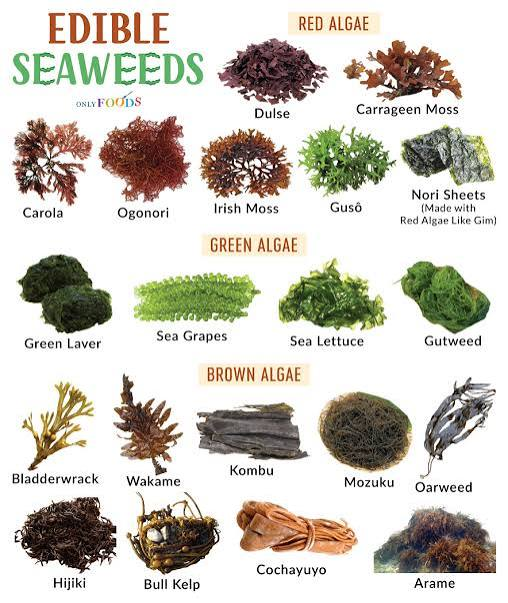
There are three main types of seaweeds -Red, Green and Brown. The brown seaweeds are the youngest of the group but are also the largest in number. The brown seaweeds are the ones that grow into the huge kelp forests in California. If you have never swam through these, they are pretty impressive. I grew up swimming in the Pacific waters of California, and have swam through these gigantic underwater forests many times. They can grow up to a foot a day.

Green algae (Chlorophyta) are a large, diverse group of simple, plant-like organisms that contain chlorophyll a and b. They live in fresh water, marine habitats, and damp land. They form the evolutionary link to land plants, store food as starch, and range from single microscopic cells to large seaweeds like sea lettuce. They prefer more shallow waters than their red and brown cousins. Green seaweeds are the ancient ancestors of terrestrial plants. Just like forests on land, all seaweeds use photosynthesis: they convert sunlight and carbon dioxide into energy, a process that produces oxygen. In a world where scientists estimate every second breath of air we take comes from the ocean, the importance of seaweed and algae to human health can not be overstated. Seaweeds have been used for everything from food to medicine to insulation to many of the indigenous peoples around the world throughout the ages. Now, seaweeds are also being used as plastic alternatives. They are also used in cosmetics too.

Red seaweed is scientifically known as Rhodophyta or red algae. This large group contains over 7,000 species that get their unique pink, purple, or red color from special pigments called phycoerythrin. Red seaweed (Rhodophyta) is found worldwide in marine environments, thriving mostly in coastal rocky areas, tide pools, and deeper ocean waters down to 30 meters or more. They are most diverse in warmer tropical seas, but common edible and local species also grow along colder northern shores in the Atlantic and Pacific oceans. Red seaweeds are mostly eaten in the Asian countries as well as in parts of Europe. Their cell walls yield valuable hydrocolloids like agar and carrageenan, which are used to thicken foods like ice cream, pudding, and jellies, as well as in cosmetics and laboratory science. Many types of red seaweed are used all the time for things like the Nori for sushi or soups; or Irish Moss (Chondrus crispus): A spiny red seaweed used to make natural thickeners; or Dulse (Palmaria palmata): A flat, leafy red seaweed often eaten as a salty snack.

Seaweeds are very healthy for us. They are 9% carbohydrates, and are great sources of iodine, sodium, iron and calcium, as well as fatty-3 omegas and are very low in fat. They also contain Vitamins A, C and E. Seaweeds are recommended for people with thyroid problems, because they are so high in iodine, which the thyroid needs to regulate metabolism and energy. (I guess I need to start eating more seaweed). Seaweed is a complete protein, containing the nine essential amino acids your body needs to build muscle, repair tissue and transport nutrients around your body. But most people (even those who follow plant-based diets) don’t usually eat enough seaweed for it to be considered a major source of dietary protein.
Eating seaweed is generally safe. But there are some potential health risks if you eat too much or have certain health conditions. Seaweed can act like a laxative when you eat too much, causing you to run to the bathroom. This problem is more common in people with digestive issues like irritable bowel syndrome (IBS). Seaweed, especially brown seaweed or kombu, contains a high amount of iodine. Your body needs this mineral for healthy thyroid function. But too much iodine can lower your body’s natural production of thyroid hormones, causing an underactive thyroid (hypothyroidism). Also, depending on where you obtain your seaweeds, some may contain higher levels of metal than others. Some waters are more contaminated and contain higher levels of metals in the water, that is then absorbed into the seaweeds. Most seaweed sold in the U.S. comes from seaweed farms in the ocean or saltwater tank farms. And studies indicate that edible seaweed tends to have low levels of toxic metals. Taking in a small amount of metals from seaweed dishes or supplements shouldn’t pose a health risk. But just like with anything, eating seaweed in moderation is key. Too much of a good thing can easily become a bad thing.

Add a little seaweed, or manna from the sea, to your diet and perk things up a bit. Have a great day and make everyday great. Life is short. Live life to the fullest and enjoy the ride. ‘Til next time.


 A Jeanne in the Kitchen
Honestly, you come up with the most fascinating topics!
LikeLiked by 1 person
SWEET!!! Thank you. I do my best. I want to keep you engaged. 🙂
LikeLike
Wow – always learning with you!
LikeLiked by 1 person
SWEET!!! That’s the plan Ma’am. 🙂
LikeLiked by 1 person
What an interesting post! I didn’t know you swam through the seaweed forest, you are so cool!
LikeLiked by 1 person
Thank you. That I did. No, not so cool, just adventurous. 🙂
LikeLiked by 1 person
You’re both!
LikeLiked by 1 person
AWWWWW!!!!! Thank you. 🙂
LikeLiked by 1 person
🙂
LikeLiked by 1 person
We love seaweed chips!
LikeLiked by 1 person
Those sound interesting. 🙂
LikeLiked by 1 person
Love seaweed
LikeLiked by 1 person
It is pretty tasty. 🙂
LikeLiked by 1 person
And very good for you
LikeLiked by 1 person
Yes indeed. 🙂
LikeLiked by 1 person
Yummmm 😋
LikeLike
Thank you. 🙂
LikeLiked by 1 person