Do you know the differences between New World Wines and Old World Wines? Did you know there even is a distinction between the two? I do, for sure. I drink and enjoy both.
Wine. The Nectar of the Gods. It has been around for 1000’s of years. Archaeological evidence indicates that wine grapes were first cultivated in the Caucasus Mountain regions of what is now known as Georgia and Armenia. From there, grapes spread to the Central, Western and Mediterranean regions of Europe. The grapes and wines from these areas are known as Old World wines. Generally, Old World history focuses on past events in Africa, Asia, and Europe—continents with ancient beginnings and places known before the exploration of the Americas. In contrast, New World history focuses on North America, Central America, and South America, and Australia and New Zealand.
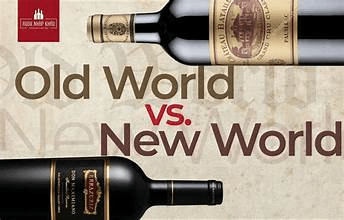
Old World wine tends to have a lighter body, lower alcohol content, higher acidity, and less fruity flavor with more minerality. New World wines tend toward a fuller body, high alcohol content, lower acidity, and more pronounced fruit flavors. Of course, this is almost like the difference between cool climate and warm climate wines.
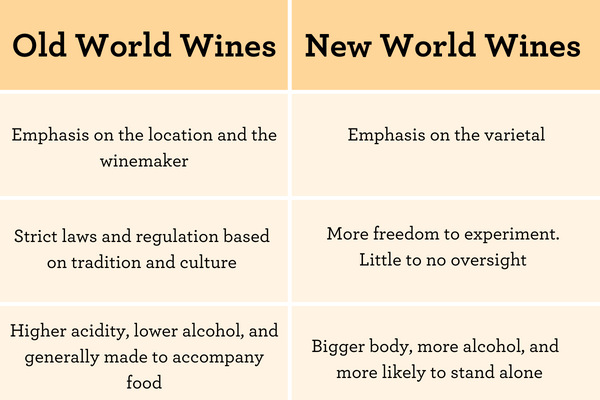
Old World Wines are steeped in centuries’ old traditions and celebrates where the grapes originated. These areas are usually in the cooler climate regions that allow the grapes to ripen slowly. The slower ripening process gives the grapes a higher acidity level, giving the wines they make a lower alcohol content. Often these wines are fermented with oak, which adds flavor and helps to maintain their balance. The oak influences and the balance they provide are part of what makes these Old World wines so palatable with so many different types of foods.

By contrast, New World Wines are known for their innovative and creative ideas. There is a lot more freedom and less restrictions placed on New World Wines and their wine making process than Old World Wines. These grapes tend to grow in warmer climates than their older, more mature counterparts. The warmer climates bring out more fruitiness and a higher alcohol content. Often times, New World Wines are bolder and heavier, and pairing them to foods can be a bit more challenging. You have to make sure the pairings will compliment both the flavors and characteristics of the wines and the food, without either one being overbearing and cancelling out the flavors of the other.
An example of the different characteristics can be found in chardonnays from both the Old World and the New World. An Old World Chardonnay, with grapes grown in the Burgundy, France region is renowned for it’s fresh acidity with mineral and green apple flavorings. A New World chardonnay, say from Napa, CA, will exhibit a rich, full-body with flavors of ripe fruit, vanilla and butter. Often times, the same grapes are used for both, but are processed in completely different ways, making two completely different wines.
By law, for the Old World wines, the label has to tell you the region’s name and vineyard where the grapes were grown. But the labels do NOT have to say what types of grapes were used, and more so than not, do not say what types of grapes are used. In Burgundy, France, all white wines are produced from chardonnay grapes and all reds are made with pinot noir grapes. In Bordeaux, white wines are usually blends that are dominated with sauvignon blanc grapes, whereas the reds are predominantly blends of both merlot and cabernet sauvignon grapes. In contrast, New World Wine labels do not focus on the region or the vineyard, but on the types of grapes used.
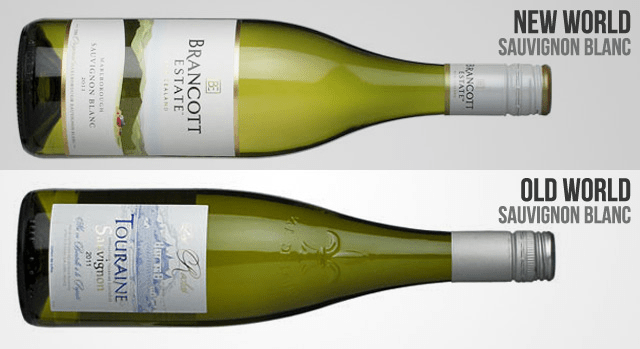

I love my wines, both Old World and New. I drink and enjoy wines from all over the world. I can definitely tell the difference between the two styles. What I drink at any particular time, just depends on how I am serving them, what I am focusing on at the time.
The old standards of pairing foods and wines were pretty simple and straight forward. Red meats and lamb went with red wines. Chicken and fish were served with white wines. Today, those same standards apply, but only loosely. Things are a lot more relaxed today. However, there are still guidelines and suggestions that are recommended and used. For my tastes, I loosely follow the above guidelines, however, I do vary them too. I also base my food and wine pairings on the type of sauce I am serving. If I am serving something with a red sauce, I will most likely choose a red wine. If that dish is chicken or fish, I will choose a lighter bodied red wine, such as a Merlot or a Pinot Noir. If a big, thick, juicy steak is on the menu, I will go much heavier on the red wine, and serve it with something like a Cabernet Sauvignon, A Cab-Franc, or a Zinfandel. If I am cooking something with a white sauce, I will choose I white wine. If the sauce is spicy, I will go with a sweeter white wine, like either a Sauvignon Blanc or a Riesling. The sweeter wines will help curb the spiciness of the dish. However, since I love to cook ethnic foods, I pair my wines and my foods with the wines from that country or region, as much as I can. If I am cooking something Spanish I will serve Spanish wines, like a Tempranillo or a Rioja for reds, and a Verdejo, or my favorite Albarino, for whites. I love my Argentine Malbecs too, especially with a good steak.
What really matters though is for you to drink wines that you like, even if that means thinking outside the box. Be adventurous and try new, or old, styles. The more wines you try, the more you will learn about them, and the more you will learn what works best for your particular style of cooking and eating. Test your wine skills and broaden your palates. But most importantly, enjoy the wines and all your wining experiences.
Have a great day and make everyday great. Enjoy some great wines along the way too. Stay safe and stay well. ‘Til next time.

 A Jeanne in the Kitchen
Interesting to read this about the difference between the old world and the new world wines!
LikeLiked by 1 person
Thank you. I love to learn new things too. 🙂
LikeLike