If you are like me, you use the terms stock and broth interchangeably. I also use both liquids interchangeably too. But believe it or not, there really is a difference between the two.
Our friend Randy, from Cook Fork Plate at https://cookplatefork.com/ actually inspired me for this idea and post. Thank you Randy.
Both stocks and broth are liquids usually made from animal carcasses, meat and vegetables that have been reduced. The main differences between the two are the type of animal part used, the length of the simmering time, and the seasoning. Stock is generally made from bones, and broth is generally made from the flesh. In both cases, they are often supported with aromatic vegetables, but in the case of stock, left unseasoned for maximum flexibility in recipes, whereas broth will usually contain at least salt and pepper. Typically made from bones and connective tissue, stock is simmered for a long time, often 4–6 hours, to break down the collagen and create a thick, gelatinous liquid. The long cooking time also allows the flavors to meld, resulting in a rich, full-bodied flavor. Stock is often left unseasoned so it can be used as a base in a variety of recipes, such as braises, sauces, and stews.
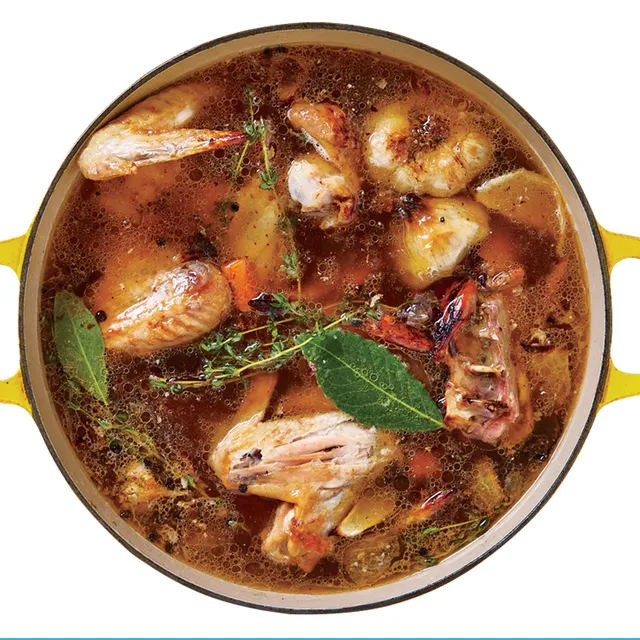
This is a typical broth. It is made with the carcass, onions, carrots, celery and a bouquet garni, or an herb bunch and water. This one is a chicken broth. As with anything, there are always different variations. Broth usually is cooked in less than 2 hours.

Stocks are made in a similar fashion, with the same basic ingredients, however, they contain the meat as well, and are slow cooked for a much longer period of time. Usually a good stock takes between 2-6 hours to prepare.
Another option is a consommé. A consommé is a clear liquid. Consommé is often confused with broth, but it’s actually a product derived from clarified broth or stock. Consommé is a clarified and concentrated stock or broth that is either usually served on its own as a soup or when cooled, used as gelatin. There are a number of methods for making a beautifully clarified consommé. All involve using egg whites, which help form a raft of solids at the surface of the stock or broth. Those solids are then skimmed off, and the broth or stock strained.

As with most things cooking related, you the cook, can always determine what is best for you to use in your own recipes. Cooking in general is using time honored ideas to prepare delicious foods. But those are just ideas and guidelines really. In order to personalize your foods, be creative and think outside the box; break from the traditions and the norms, and do what works best from you.
I hope you all learned something new today. I know I did. 🙂 Have a great day and make everyday great. Stay safe and stay well. ‘Til next time.

 A Jeanne in the Kitchen
Yes, it’s great to use all parts of the ingredients to make broths or bases! 💯
LikeLiked by 2 people
That’s what makes them so good. 🙂
LikeLiked by 1 person
Just so long as its home made
LikeLiked by 2 people
I do for the most part, but every now and then I use store bought too. 🙂
LikeLiked by 1 person
I can get “home-made” from the butcher and fishmonger
LikeLiked by 1 person
Cool. Good to know. Thanks. 🙂
LikeLiked by 1 person
Thanks for sharing this idea Anita
LikeLiked by 2 people
My pleasure. 🙂
LikeLike
Thanks for sharing. Have a great day. 🙂
LikeLike
I certainly learned, and I thank you for this information, dear Jeanne. Now I know the proper names for what I do.
LikeLiked by 1 person
Always happy to help. 🙂
LikeLiked by 1 person
😻
LikeLiked by 1 person
The secret is the “base”. 😋🌿
LikeLiked by 1 person
Absolutely!
LikeLiked by 1 person
So… a stock is made with bones, and a broth with flesh… that’s the first time I’ve had it defined so clearly! Thank you.
My question now is…
Why is bone broth a broth, and not a stock?
LikeLiked by 2 people
You are good. 🙂 I haver NO idea. They are all part of the same family though. 🙂
LikeLiked by 1 person
Ha! I was wondering the same thing. To me broth is cooked for less and stock for more time.
LikeLiked by 2 people
That is my take too. To me they are prertty interchangable. 🙂
LikeLiked by 1 person
Thank you for the shout out. have a great day. 🙂
LikeLike