New Orleans is famous for a lot of things, and particularly for its good food. Gumbo is one of those traditional signature dishes of New Orleans and the state of Louisiana. Gumbo is a thick soup that has been made famous in the city of New Orleans, and it dates back to the early times of Louisiana, and its very diverse history. Gumbo is thickened in three ways – one is with a roux and then by the use of okra, and in many recipes, it is thickened by both means. Louisianans will often proclaim that it is “gumbo weather” when the barometer drops and the weather starts to get cooler. Gumbo is the food of the people, and of their region, or Parrish. There are endless variations of gumbo. There is never just one gumbo recipe. Before refrigeration, gumbo recipes varied according to the availability of resources within a particular region.
A roux is a mixture of equal parts flour and fat, or oil that is browned to varying degrees. Butter is not usually used to make a roux, unless it has been clarified because it burns easily, and once a roux burns, it is DONE! There is NO going back. The only thing you can do when the roux is burned is to throw it away and start all over. The darker the roux, the nuttier the flavor. A light or blond roux is usually thicker than a darker roux too. A roux can be very light or very dark.
It was gumbo weather here in Denver yesterday, so I made a big pot of gumbo filled with all kinds of good things. Of course I followed the rules and added the Louisiana Trinity of peppers, onions and celery, but I also added some jalapenos and garlic to the trinity, making it more of a quintet. And I thickened it with both a medium blond roux AND okra. It came out oh so good too. Then I served it with some cornbread topped with honey butter.

By the time of the Louisiana Purchase in 1803, gumbo had become deeply ingrained in the local diet. The dish was prevalent among Cajuns, Creoles, and people of color, no matter their socioeconomic station. The word gumbo is a derivation of the African word gombo for okra, which is a vegetable that is also used as a thickening agent.
Gumbo’s varied history reflects the evolution of agricultural production and creolization, a hybridized blending of multicultural traditions, in Louisiana. Louisiana cuisine, as writer Lafcadio Hearn understood it in the late nineteenth century, is “cosmopolitan in its nature, blending the characteristics of the American, French, Spanish, Italian, West Indian, and Mexican.” While gumbo can be as varied as the cooks who prepare it, there are three essential varieties: seafood, poultry, and gombo z’herbes. My gumbo had a little bit of everything. I had some Andouille sausage, shrimp and chicken, as well as the vegetables.
Mixed Meat Gumbo
Gumbo is one of those scrumptious dishes that has no rules, none what-so-ever, except for these rules – Here are some gumbo rules that cannot, under any circumstances, be broken. Thou Shalt Always Use a Bowl. If you use a plate, it is not gumbo it is rice and gravy! Thou Shalt Only Use a Wooden Spoon. There is only one kind of spoon that can enter a gumbo pot and that is a wooden one. Most rules I don’t follow, but there are some that I do. Of course I followed these rules. 🙂 So use whatever you have on hand, even if it is only little bits of this and little bits of that. Mix it all together and throw it all into the gumbo pot.
I had a little shrimp, a little bit of Andouille sausage and a little bit of chicken. None of it was enough on its own, but used together, it was more than enough to feed five.
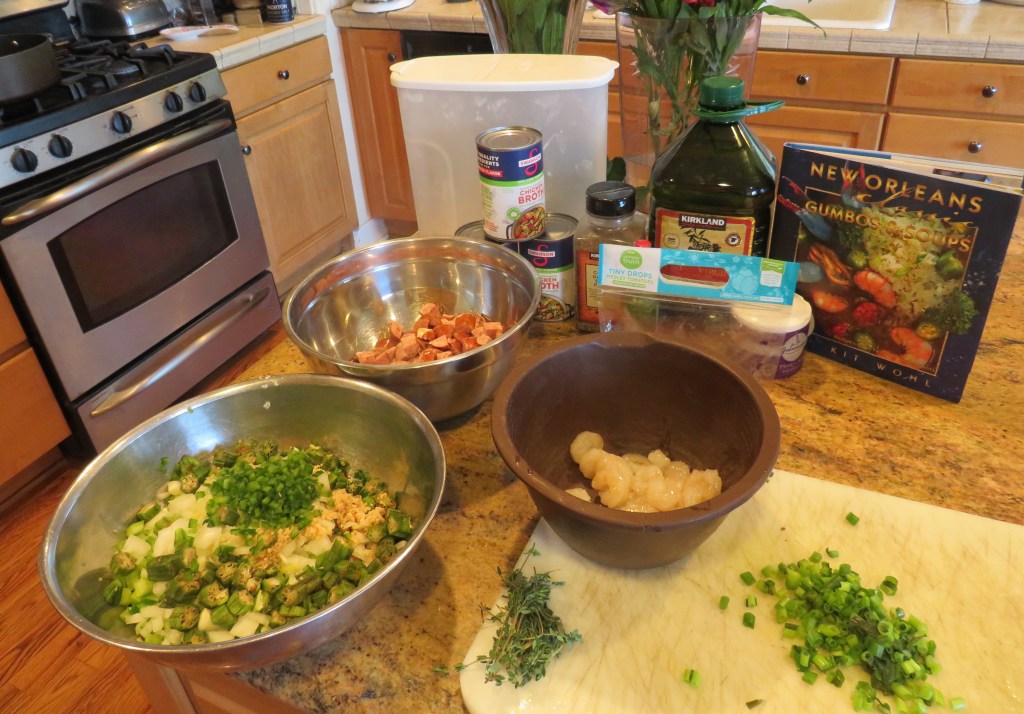
Because I was using shrimp, I did not want an over powering roux or flavor. So I purposely chose to use a lighter, more blond version. I used 1 cup of flour and 1 cup of canola oil. A light roux only takes a few minutes of whisking it constantly until you get your desired thickness and/or color. A dark mahogany roux can take between 45-60 minutes.

Once my roux was almost to the point where I wanted it, I added my vegetables and cooked them with my roux. A traditional trinity uses only green bell peppers, but that is changing with the times, and more and more people are using mixed colored peppers. I like to mix them. The proportions for a trinity are 2 parts chopped yellow onion, 1 part chopped celery, and 1/3 part chopped green or mixed bell peppers.
I cooked my meats first, separately, then re-added them again later.

When the vegetables are softened and cooked, and the roux is to the color and consistency you like, add between 6-8 cups of chicken, or vegetable broth. If you like it a little thinner, add more.
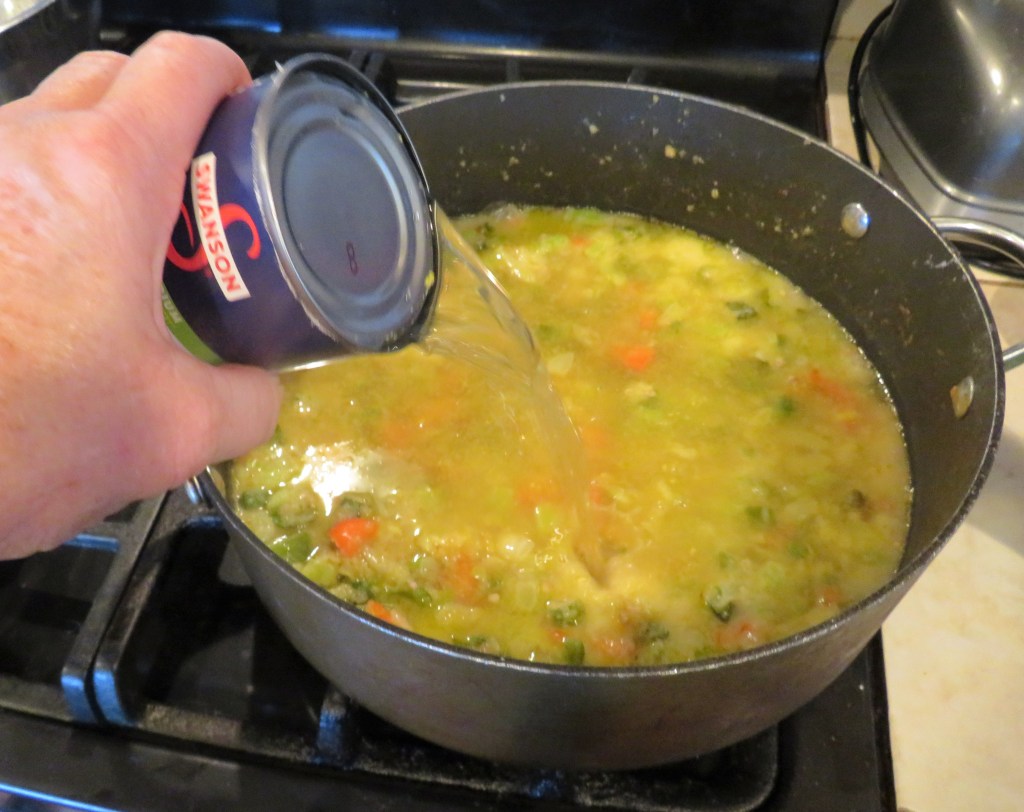
Bring everything to a boil, then reduce the heat to a simmer and continue to cook for about 1-1 1/2 hours, stirring occasionally. Re-add the meat towards the end of the cooking process, but make sure to give it enough time to let it heat thoroughly and cook thoroughly.
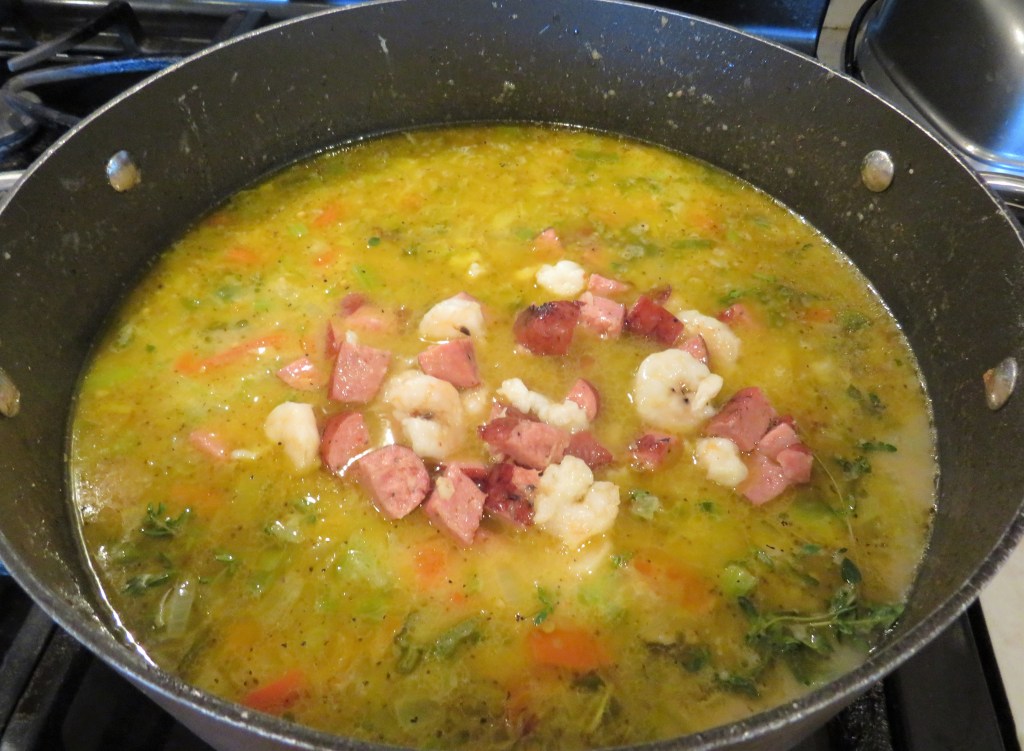

When it is ready, serve it IN A BOWL, with some cooked rice, or rice and beans, and laissez le bontemps roulez!

I GAR-UN-TEE y’all are goin’ to LOVE this.
Have a great day and make everyday great. Stay safe and stay well. ‘Til next time.

 A Jeanne in the Kitchen
Gumbo is something I’ve never had! I am unsure if I’d like it!
LikeLiked by 1 person
You never know until you try it. 🙂
LikeLiked by 1 person
Perfect for a chilly day Jeanne
LikeLiked by 2 people
Thank you. It sure is. 🙂
LikeLiked by 1 person
That seems delicious. I love Gumbo.
LikeLiked by 1 person
Thank you. It was very good. 🙂
LikeLiked by 1 person
Good to see you posting again. I had you followed ages ago before I went inactive for almost a year.
LikeLiked by 1 person
I’ve never stopped. I try to post something everyday. 🙂 Welcome back. 🙂
LikeLiked by 1 person
Thanks. If you didn’t hit a dry spell back then it must have been WordPress goofing up notifications.
LikeLiked by 1 person
That could have been. I haven’t stopped at all. 🙂
LikeLiked by 1 person